When my father died, grief didn’t arrive in a dramatic collapse.
It came quietly.
It settled into ordinary moments—the instinct to text him something trivial, the pause when I passed his favorite chair, the silence that lingered just a second too long. Loss didn’t announce itself. It stayed.
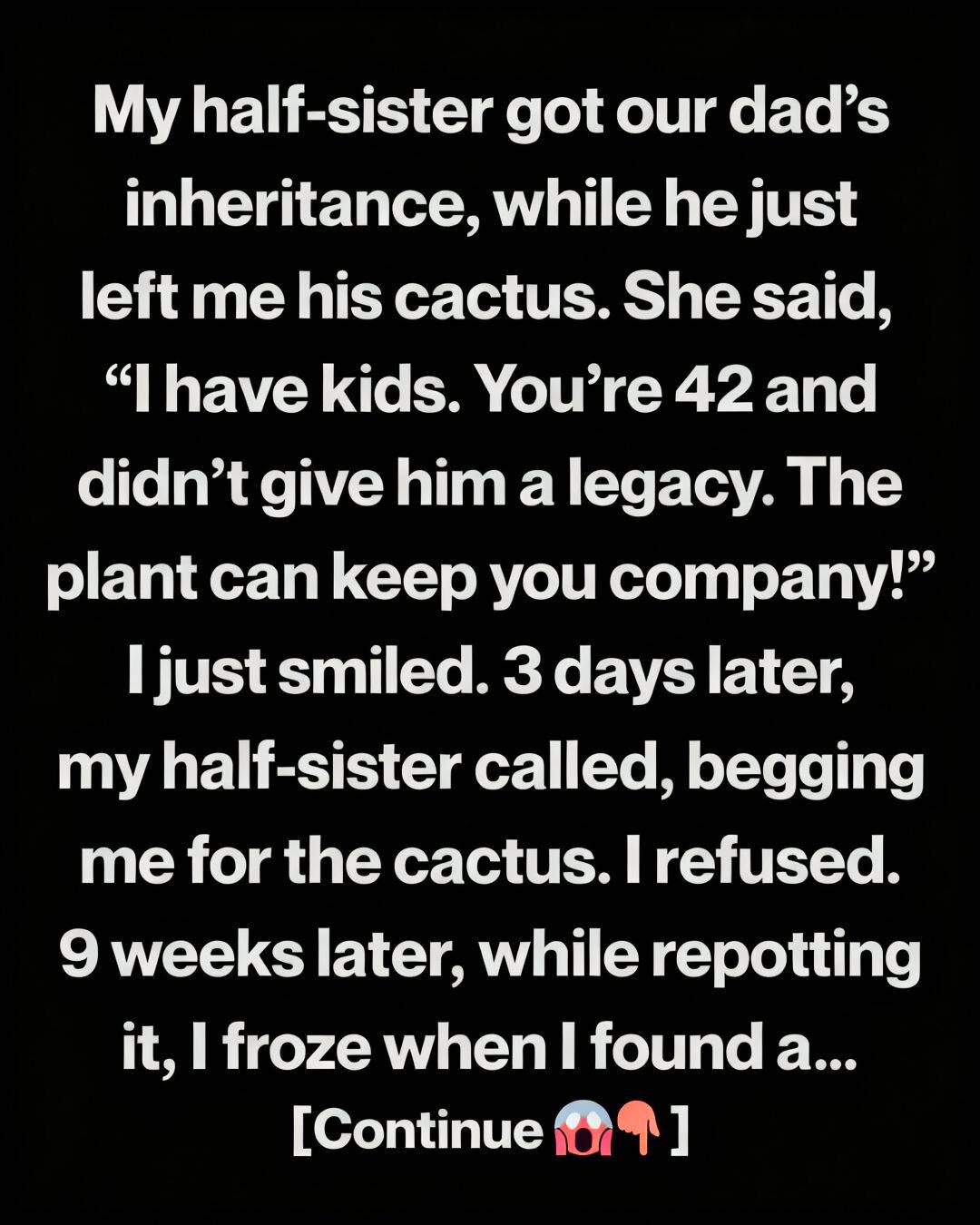
The reading of the will was brief and clinical, stripped of emotion by legal phrasing and polite pauses. My half-sister sat across from me, composed and expectant. She inherited the house, the accounts, the investments—everything with an obvious price tag and social weight.
Then the attorney looked up and read my name.
I was left one thing.
My father’s old cactus.
The same cactus that had sat by his living room window for decades—awkwardly shaped, duller than any plant you’d choose on purpose. My half-sister laughed. Not cruelly, just dismissively. She said she had children to think about. Real responsibilities. Real needs. At forty-two, she added, I was surely fine with something small.
The message was clear: be grateful, be quiet, don’t complicate things.
I didn’t argue. I didn’t explain. When the time came, I picked up the cactus, cradling its cracked ceramic pot as if it mattered, and carried it home.
That night, I set it on my kitchen table and stared at it longer than I expected.
It wasn’t decorative.
It wasn’t impressive.
It wasn’t worth anything on paper.
But it felt deliberate.
My father was never good with speeches or emotional clarity. He spoke through habits, through objects that stayed. He once told me the cactus reminded him of resilience—how it survived neglect, endured long dry stretches, and still found a way to grow. He admired that. In his own quiet way, he lived by it.
Three days later, my half-sister called.
Her voice was different now—measured, careful. She said she’d been thinking about the cactus. Said it meant more to her than she’d realized. Asked if I’d consider giving it to her after all.
I listened. Then I said no.
Not out of spite. Not out of revenge.
But because that plant was the only thing untouched by negotiation, resentment, or accounting. It was the one piece of my father that hadn’t been divided, evaluated, or priced.
It was personal.
Weeks passed. The cactus became part of my routine. I learned when it needed water—and when it didn’t. I rotated it toward the light. I noticed small changes: new growth, subtle signs of life that would’ve been easy to miss if I weren’t paying attention.
In a world obsessed with visible success, it demanded patience instead.
One afternoon, I decided to repot it. The soil was old—compacted, tired. As I gently loosened the roots, my fingers brushed against something firm.
I stopped.
Carefully clearing the dirt, I uncovered a small sealed envelope, yellowed with age but intact.
My hands shook as I opened it.
Inside was a short handwritten note from my father.
No grand confession.
No apology tour.
Just honesty.
He wrote that he knew he hadn’t always done things right. That he’d made mistakes—some he could fix, some he couldn’t. He wrote that he was proud of me, not for achievements or milestones, but for building a life rooted in kindness rather than expectation.
And then he wrote this:
The cactus was never just a plant.
It’s a reminder that worth isn’t measured by appearances, assets, or inheritance lists.
Something shifted as I read those words.
He had known exactly how it would look on the surface. He chose simplicity over spectacle. Intention over optics. In a culture obsessed with wealth, estate disputes, and what gets divided after death, he left me something quieter—and far more enduring.
I didn’t tell my half-sister about the note.
Not because I wanted to deprive her of anything, but because that message wasn’t communal. It wasn’t meant for discussion or validation. It was meant for me.
Inheritance doesn’t always mean entitlement. Sometimes it’s a private transfer of meaning, invisible to everyone else.
Today, the cactus still sits by my window. It doesn’t draw attention. Visitors don’t comment on it. It doesn’t signal status or success.
But it grows.
Slowly. Persistently.
It reminds me that legacy isn’t always loud, and love isn’t always obvious. Some of the most valuable gifts arrive disguised as nothing special at all.
And every time I water that cactus, I remember:
my father finally found the words he couldn’t say out loud.
He just hid them somewhere only I would think to look.