The ocean was the first thing I noticed that night—loud, steady, almost breathing beneath the windows.
I had every door in the house open.
The home sat above the cliffs in Monterey, all white stucco, cedar roofing, endless glass facing the water, and a terrace wide enough for dinners that actually meant something. Six bedrooms. A pale stone kitchen. A staircase designed to look elegant without begging for attention.
At sunset, the Pacific turned silver, then violet, then a deep blue so rich it looked unreal. At seventeen, right after my mother died, I might have dreamed of some dramatic mansion full of towers and fireplaces. At thirty-four, I wanted something simpler. Light. Quiet. Space. A house where I could open the door and never have to justify my existence to anyone on the other side.
Every dollar that bought that house was mine.
That mattered more to me than the number, though five point six million had impressed plenty of people. My mother used to clip coupons with kitchen scissors and sort money into envelopes for school clothes and holidays. She always said, “Money is freedom wearing practical shoes.” At ten, I thought she was joking. At thirty-four, I knew she had been teaching me survival.
That first evening, I poured wine, sat on the terrace, and let myself be happy. No speeches. No champagne. No triumphant post about success. I had uploaded one discreet story earlier—just the edge of the terrace and a strip of ocean—then set my phone down and let the waves make silence feel full.
I remember thinking I had finally stepped all the way into my own life.
Then my phone rang.
My stepmother, Miranda Hale, never called late unless the lateness itself was part of the move. She liked catching people tired, alone, and off balance.
“Charlotte,” she said brightly, as if we were already in the middle of a pleasant conversation. “I’m so glad you answered. Brooke just showed me your little beach place. How exciting.”
Little beach place.
I said, “Good evening to you too.”
She ignored it. “Your father and I are coming tomorrow. We’ll take the master, of course. Brooke wants that upstairs ocean-view room with the balcony, so make sure that’s ready for her. You can use one of the smaller back bedrooms. You’ve never been precious about space.”
For a second I thought I had heard wrong.
Not because Miranda was incapable of entitlement. She built her whole life on entitlement polished until it looked like elegance. But the scale of it was so naked that it took my brain a moment to catch up. It was nearly midnight. I’d owned the house less than twelve hours. And my stepmother was informing me that she, my father, and her daughter were moving in.
“The next day?” I repeated.
“Yes. Your father wants sea air, and honestly, that house is far too much for one person. It’ll be lonely for you. Wasteful. We’ll make it lively. Brooke’s been desperate to leave that apartment anyway.”
Brooke was thirty-one and had been desperate to leave at least six times in the past four years—usually whenever rent or consequences showed up.
“I don’t remember inviting anyone to move in,” I said.
Miranda sighed gently. “Don’t be difficult. Family doesn’t need engraved invitations. We’ll leave by ten. Turn down the linens in the master. And Brooke has very sensitive skin, so tell your housekeeper not to use fabric softener on her sheets.”
I actually laughed once. “I don’t have a housekeeper.”
Pause. Then coolly: “Well. Then perhaps you should.”
That certainty didn’t make me angry in the hot way. It made everything inside me go cold and clear. She was too comfortable. Too practiced. This was not an impulse. It was a system.
“I’d like to speak to my father,” I said.
“He’s asleep.”
Too fast.
“At eleven forty-seven?”
“He’s tired, Charlotte.”
My father had not fallen asleep before midnight in twenty years.
“I’ll call him tomorrow,” I said.
“No need,” she replied, pleased now, because she thought she had won. “We’ll see you at noon. And Charlotte? Don’t start this off sourly. If you don’t like the arrangement, you’re free to stay somewhere else. You’ve always liked being independent.”
There it was. Her favorite line. For fourteen years she had used it to turn exclusion into praise.
I smiled into the dark.
“Of course,” I said. “I’ll have everything ready.”
She relaxed. “I knew you’d be sensible.”
Then I called my father.
He picked up immediately.
“Charlotte? Everything okay?”
My father, Michael Hayes, was seventy-one, successful in commercial real estate, emotionally absent in the polished, respectable way certain men become. He was not cruel. He was simply a man who had always expected women to absorb domestic life for him. After my mother died, he never really learned how to be home without someone arranging home around him.
“Were you asleep?” I asked.
“No.”
“Miranda just called and said you’re moving into my house tomorrow. That you’re taking the master, Brooke gets the upstairs suite, and I can leave if I don’t like it.”
Silence.
Then: “What?”
I closed my eyes.
That was the moment everything shifted—not because Miranda tried to take my house, but because for the first time I heard surprise in my father’s voice where she had counted on consent.
“She said you were coming tomorrow,” I repeated.
“Charlotte, no. She told me you invited us for a long weekend. Said you didn’t want to settle into that big place alone. I never agreed to move in.”
“And Brooke?”
“She said Brooke might stop by.”
His version had the clumsy incompleteness of truth. Hers had the smooth shape of a practiced lie.
“Do you want to come tomorrow?” I asked.
Pause.
“Yes,” he said finally. “Now I do.”
So the next morning I made up two guest beds.
Not because I meant to surrender the house. Because when someone arrives carrying a lie like luggage, the smartest thing you can do is give it room to reveal itself.
My mother died when I was seventeen. After that, I became useful—grocery lists, paperwork, errands, never needing too much. Two years later my father married Miranda. She arrived graceful, tasteful, perfectly composed, with a daughter named Brooke and a gift for editing reality. My old bedroom became Brooke’s dressing room while I was away at college because I was “hardly ever home.” Family pictures were taken without me because I was “always so independent.” Brooke’s tuition and crises were urgent; my needs were character-building exercises. Miranda never fought loudly. She revised quietly.
So I stopped explaining myself.
I built instead.
Finance. Consulting. Operations work. Long hours. Strategic investing. Real estate partnerships. Quiet discipline. At family dinners, Miranda would wave a hand and say I did “something with spreadsheets.” I let her. Underestimation is useful.
By the time I bought that house in Monterey, I had built a life sturdy enough to hold me.
The next morning, two black SUVs pulled into the drive.
Miranda swept in first without knocking, all warmth and ownership. My father followed, slower, already tired. Brooke came last in sunglasses, announcing, “This place is literally insane.”
Miranda surveyed the foyer. “Master first,” she told the driver. “Brooke’s things upstairs by the balcony room. Charlotte, show him.”
So I did.
That is the part people misunderstand. They think silence means surrender. Sometimes silence means someone has stepped out of the argument and into documentation.
I let the bags go where Miranda assigned them. I let Brooke gush over the upstairs room. I let Miranda stand in the master and say, “This feels right, doesn’t it, Michael?”
He looked at me. One second. Enough to say: I know. I’m sorry. Not yet.
By noon, my clothes had been moved into a smaller room at the back of the house, facing the service drive instead of the ocean. Not by me. By Miranda and Brooke.
So I took photographs.
Every drawer they emptied. My dresses jammed into the wrong closet. Brooke’s absurd skincare refrigerator plugged into the best room in the house. The orchids Miranda placed in the foyer as if she were mistress of the estate. The timestamped call from the night before.
Then I called my attorney, Nathan Cole.
He listened, then said, “Please tell me there’s a second reason you’re calling.”
There was.
Months earlier, after my father’s heart scare, I had asked Nathan to quietly review some paperwork tied to my father’s property in Newport. Something about a transfer document had bothered me.
Now he pulled everything.
By afternoon, he called back and said, “Sit down.”
An LLC had been formed in Miranda’s name. My father’s Newport house had been transferred into it through a deed with a suspicious signature. Retirement funds had been moved. A line of credit opened in his name during his recovery. Donations made in Miranda’s name were funded by money she should not have had access to.
And then Nathan added one more detail.
Miranda had been selected as Philanthropist of the Year for the California Justice Foundation Gala.
Of course she had.
Miranda loved philanthropy the way some women love flattering lighting—not for what it did in the world, but for what it made her look like.
Over the next eighty-three days, she lived in my beach house like a woman rehearsing a magazine profile. Monogrammed towels arrived. She replaced the flowers I chose. She referred to the master suite as “our room” by day two. Brooke turned the house into social media content. My father moved through it all with the expression of a man realizing far too late that the domestic world he had delegated for years had been weaponized against him.
I gave up space outwardly. Inwardly, I built a file.
Nathan moved fast. So did the forensic examiner and accountant. The deed signature was almost certainly forged. The transfers were real. The donations traced back to disputed funds. Ethics counsel for the foundation was quietly informed.
Meanwhile Miranda kept handing me evidence. She practiced her acceptance speech in my kitchen while wearing diamonds purchased from money she had siphoned from my father. Brooke bragged on speakerphone that the gala gifts were technically “Dad’s money, but same difference.” I recorded times, dates, details.
Three weeks in, my father knocked on my bedroom door after midnight.
He sat in the chair by the window and looked older than I had ever seen him.
“This should not have happened,” he said.
“No,” I replied.
He admitted Miranda told him it was a visit. He admitted she handled his paperwork after his recovery. I handed him the documents Nathan had compiled. He read them and went pale.
“She said it was estate simplification,” he murmured.
“It was access,” I said.
He looked at me and finally said the one sentence I had waited years to hear.
“I should have protected you from her.”
“Yes,” I said. “You should have.”
Then he asked, “What do you need from me?”
“A sworn affidavit,” I said.
He signed it.
Once he did, the whole thing stopped being suspicion and became a case.
The foundation board reviewed the reports. The gala award was quietly revoked pending ethics review. Judge Eleanor Brooks, chair of the gala committee, requested a confidential meeting with me. She was precise, unsentimental, impossible to impress. After reading the file, she asked, “What do you want?”
“The truth in the room she built her reputation for,” I said.
She nodded. “Then attend the gala. Bring a sealed envelope.”
The day of the event, Miranda told me to iron her shawl and wear something simple because “the evening isn’t about you.”
She was right about one thing.
It wasn’t.
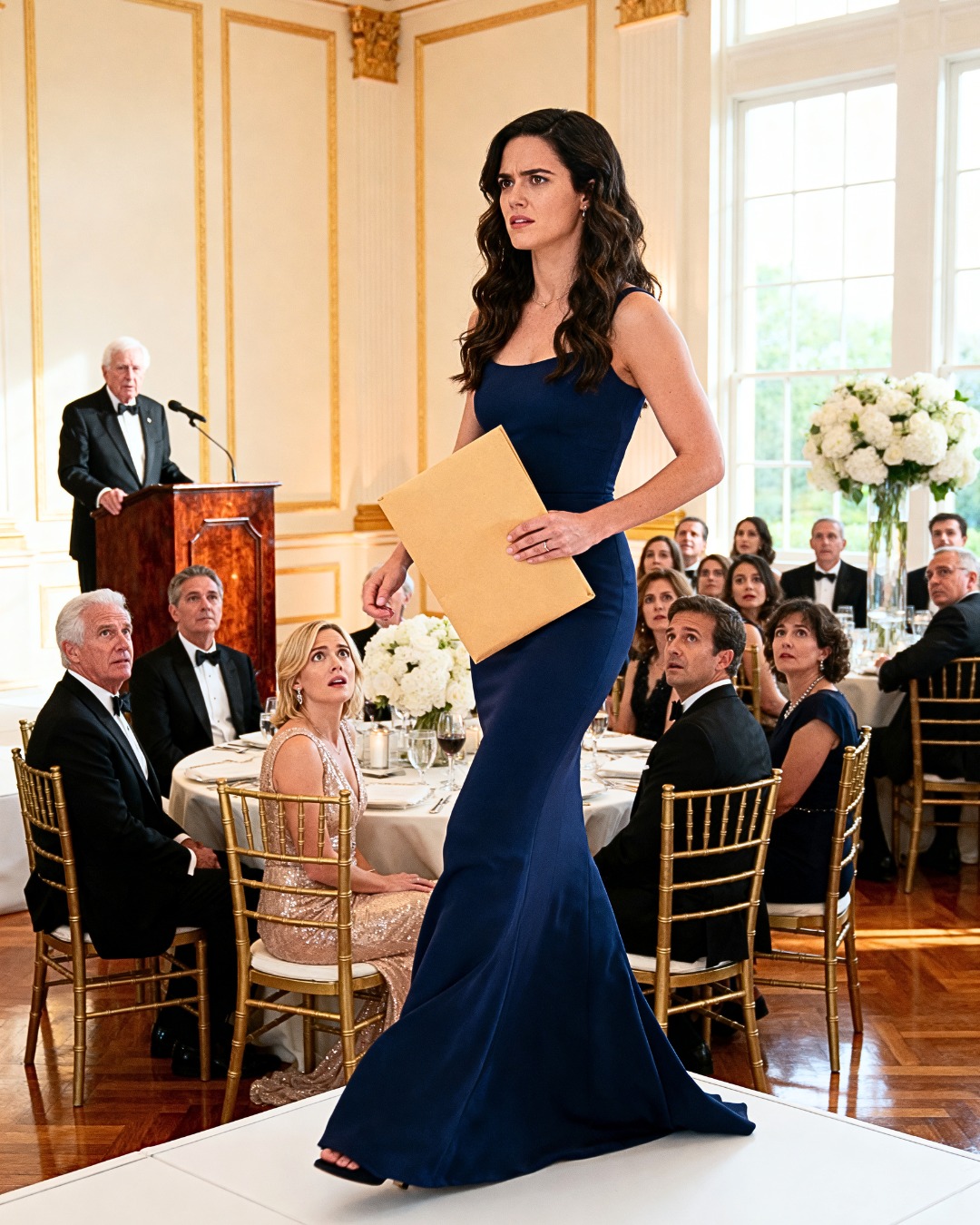
I wore black. Simple, severe, my mother’s pearl earrings. Nathan met me in the hotel lobby and said, “You look like a verdict.”
The ballroom held two hundred and twenty guests. Judges, donors, attorneys, cameras. Miranda gleamed at the front table in champagne silk. Brooke floated nearby, hungry for reflected importance. I sat near the back, by design.
At 9:12, just as the emcee began introducing Philanthropist of the Year, Judge Brooks stood and stepped to the microphone.
The room changed.
She announced that the final award had been revoked pending urgent ethics concerns tied to the source of the honoree’s funds.
Then she said, “Ms. Charlotte Hayes, would you please come forward.”
Time slowed.
I picked up the sealed manila envelope and walked down the aisle.
Vanessa—no, Miranda—found me with her eyes halfway there.
I stepped onto the stage.
“Before you celebrate her,” I said, holding up the envelope, “there’s something you need to see.”
I handed it to Judge Brooks and ethics counsel.
Miranda stood. “Charlotte, sit down.”
That sentence died in the air.
“No,” I said.
Judge Brooks addressed the room: the packet contained my father’s sworn affidavit, forensic analysis, and financial records indicating that Miranda’s charitable reputation had been built with unauthorized funds.
Miranda tried to laugh it off as a bitter family dispute.
Then my father stood.
“It’s true,” he said.
The room went still.
He confirmed the deed was unauthorized. The credit line unauthorized. The funds moved without permission.
Miranda told him to sit down.
He didn’t.
That was the real collapse—not the gasp in the ballroom, not Brooke crying, not the donors recoiling. It was the moment Miranda realized she no longer controlled the first version of the truth.
The gala recessed. Security quietly closed in around her table. Nathan came to my side and said, “You did exactly enough.”
Judge Brooks thanked me for bringing facts instead of spectacle.
My father approached me and said quietly, “I should have listened to you a long time ago.”
“I know,” I said.
That night he came home with me, not to the master, but to sit at my kitchen island and finally begin untangling fourteen years of distortion.
The legal aftermath moved fast. The deed transfer was voided. The line of credit frozen. Funds traced. Miranda lost her board seats, her donor standing, her invitations. Brooke fled to Manhattan with some photographer and an online story about betrayal. My father moved into the guest suite while separate counsel handled the rest.
Eventually the civil case settled in our favor. Miranda was never dragged out in handcuffs; life is rarely that tidy. But consequences came anyway. Professional exile. Social disappearance. Permanent loss of access.
As for the house, it finally became mine in the way it should have been from the beginning.
I didn’t move back into the master right away. For two weeks I stayed in the back room because I needed the house to exhale first. Then one morning I opened the windows, stripped the bed, sent the monogrammed towels away, put my books back on the table, and reclaimed the room slowly, without ceremony.
In August, I hosted dinner for the first time. Nathan came. Judge Brooks came. My father sat at the table and admitted the ocean view was best from the head seat. No gala rehearsals. No donor theater. Just dinner.
Judge Brooks looked around the table and said, “It’s better like this.”
She didn’t mean the menu.
She meant the house no longer bracing around someone else’s performance.
People later asked why I let Miranda come in at all. Why I didn’t throw her out that first morning. Why I gave up the master suite.
Because immediate opposition would have fed the narrative she had spent years building about me. Difficult. Sensitive. Independent. Ungrateful.
Instead I gave her room.
And in the room she took, she revealed everything.
That was the lesson of the house. Not that patience is always noble. Sometimes patience is fear in good tailoring. But sometimes patience is evidence gathering. Sometimes silence is architecture. Sometimes the most devastating answer to someone who mistakes your restraint for weakness is to let them finish decorating the trap themselves.
I still live in Monterey.
My father moved back to Newport once the property issue was resolved. We have dinner every other Sunday. Repair at this age is not dramatic. It is mostly consistency.
Sometimes I think of Miranda in whatever smaller life she found after the gala. I don’t stay there long.
What I stay with is the terrace at dusk. The salt air. The windows open wide. The simple, untouched pleasure of walking through rooms no one is trying to take from me.
The first time a friend came to stay after everything settled, she stood in the upstairs ocean-view room—the one Brooke had once claimed like a trophy—and said, “This is the best room in the house.”
I handed her the key.
“Good,” I said. “It’s yours for the weekend.”
That felt like the true ending.
Not the stage.
Not the envelope.
Not Miranda’s face when Judge Brooks said my name.
The true ending was a room taken back not by force, but by freedom. A daughter no longer standing on the edge of someone else’s version of the family waiting to see if she would be allowed inside the frame.
My name is Charlotte Hayes. I am thirty-four years old. My mother died too young. My father learned too late. My stepmother mistook my quiet for emptiness, my patience for permission, and my independence for weakness. She moved my clothes into a back bedroom in a house I bought with my own money and told me to wear something simple because the evening wasn’t about me.
She was right.
It wasn’t about me.
It was about the moment a lie finally ran out of rooms to hide in.