My name is Evan Carter, and three years ago I was convinced my life was finally settling into something solid and predictable.
I was thirty-six, managing operations for a construction supply company just outside Dayton, and everything felt… stable. I had a modest house I’d spent years paying down, a routine that made sense, and in three months, I was supposed to marry Rachel—the woman I believed had stood beside me through the hardest chapter of my life.
That chapter began when my father passed away.
After he was gone, my mother, Margaret, couldn’t stay in her house alone anymore. She was eighty, proud in that quiet way older people are, but slower now, more fragile. Grief had hollowed out her world. The house she’d shared with my dad for decades suddenly felt too large, too silent, too heavy with memories.
So I brought her to live with me.
Rachel told me she understood. She held my hand at the funeral, squeezed it tight, and whispered, “We’ll take care of her together.”
And I believed her—because I wanted to believe in the version of our future where everything worked out. Love can do that. It smooths over the edges of things that don’t quite fit, convincing you they’ll settle into place eventually.
At first, the signs were small.
Rachel would sigh when Mom left a mug in the sink. She’d make comments about the TV being too loud. She’d complain that Mom repeated herself. Nothing explosive. Nothing I couldn’t explain away.
“She’s just stressed,” I told myself. “Wedding planning… work… everything piling up.”
And yes, Mom could be forgetful. Rachel liked things neat, structured. I kept telling myself it was just an adjustment period. That it was my job to keep the peace.
So I did.
I smoothed things over.
I reassured both of them.
And without realizing it… I stopped really paying attention.
That Thursday, everything changed.
I left work early because a supplier meeting got canceled. It felt like a small, lucky break. I didn’t text ahead. I thought I’d surprise them—grab dinner from Mom’s favorite diner, maybe sit together, relax for once.
I walked into the house quietly, balancing the takeout bag in one hand.
And then I saw her.
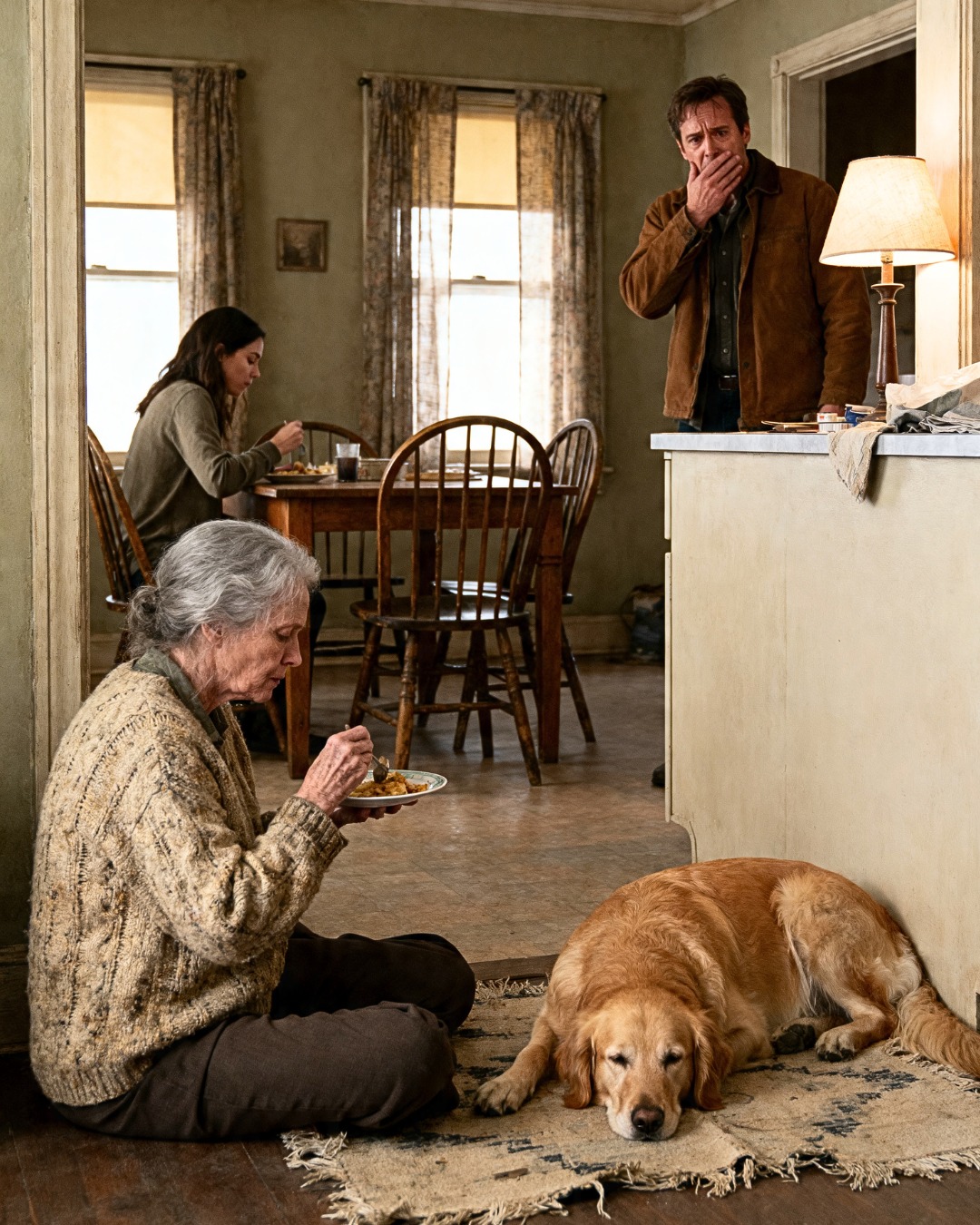
My mother… sitting on the kitchen floor.
Not at the table.
Not even on a chair.
On the cold hardwood, beside the pantry, her back slightly hunched, a plate resting carefully on her lap. Meatloaf, mashed potatoes, green beans. She ate slowly, deliberately, like she was trying not to draw attention to herself in her own son’s home.
Rachel stood at the counter, scrolling through her phone.
I dropped the bag so hard the drinks tipped over inside it.
Rachel turned, startled—then annoyed.
My mother flinched.
“What the hell is this?” I asked, my voice already shaking.
Rachel barely looked concerned. “She spilled water at the table earlier. I just cleaned the chairs. She can eat there tonight.”
I stared at her.
“On the floor?”
She crossed her arms. “She’s old, Evan. She doesn’t need special treatment.”
My hands started trembling. “That’s my mother.”
Mom kept her eyes down, like she wished she could disappear.
That hurt more than anything Rachel had said.
I stepped toward her, but before I could speak, Mom whispered, barely audible, “Please don’t make this worse.”
Rachel scoffed. “Maybe if you actually saw what I deal with all day, you’d stop acting like I’m the villain.”
That was the moment everything snapped into focus.
This wasn’t one bad moment.
It wasn’t stress.
It was a pattern.
And I had just walked in on the part she could no longer hide.
I helped my mom up gently. She felt so light leaning against me, like she had already started shrinking under the weight of something I hadn’t seen.
I guided her to the living room, sat her down, then knelt in front of her.
“Has this happened before?”
She hesitated. Looked toward the kitchen. Then back at me.
At first, she shook her head.
Then she sighed… and gave up trying to protect me.
“A few times,” she said quietly.
It felt like something broke inside my chest.
“A few times?” I repeated. “Mom… why didn’t you tell me?”
Her eyes filled, but she didn’t cry.
“Because this is your home,” she said. “Your life. You were happy. I didn’t want to be the reason you lost it.”
That sentence… I’ll carry it forever.
I stood up, anger rising so fast it almost made me dizzy.
Rachel was in the kitchen, waiting, arms crossed, already defensive.
“Before you start,” she said, “you have no idea what it’s like being here with her. She’s forgetful, stubborn, messy. I’m trying to keep this house under control.”
“You made my mother eat off the floor.”
“She spilled tea all over the chair,” Rachel snapped. “I told her to wait. She sat down there herself.”
I stared at her. “Do you hear how that sounds?”
“She’s being dramatic. And now so are you.”
I had loved this woman.
I had planned a future with her.
But standing there, something inside me went cold.
Because even if her version were true, any decent person would’ve helped my mother to another seat. Brought her food to the couch. Done anything but leave her on the floor like she didn’t matter.
Then my mother’s voice came from behind me.
“That’s not true.”
It stopped everything.
Rachel froze.
Mom stood in the doorway, holding onto the wall for support.
“She said I was getting too comfortable,” Mom continued. “She said if I wanted to live here, I should remember whose kitchen it would be after the wedding.”
I turned slowly toward Rachel.
She tried to recover. “She’s twisting things.”
Mom shook her head. “She told me not to bother you. Said you had enough stress. That if I kept causing problems… you might have to find somewhere else for me.”
There it was.
The truth I had refused to see.
Rachel looked at me and said, “Maybe I was trying to protect our future.”
“By humiliating my mother?”