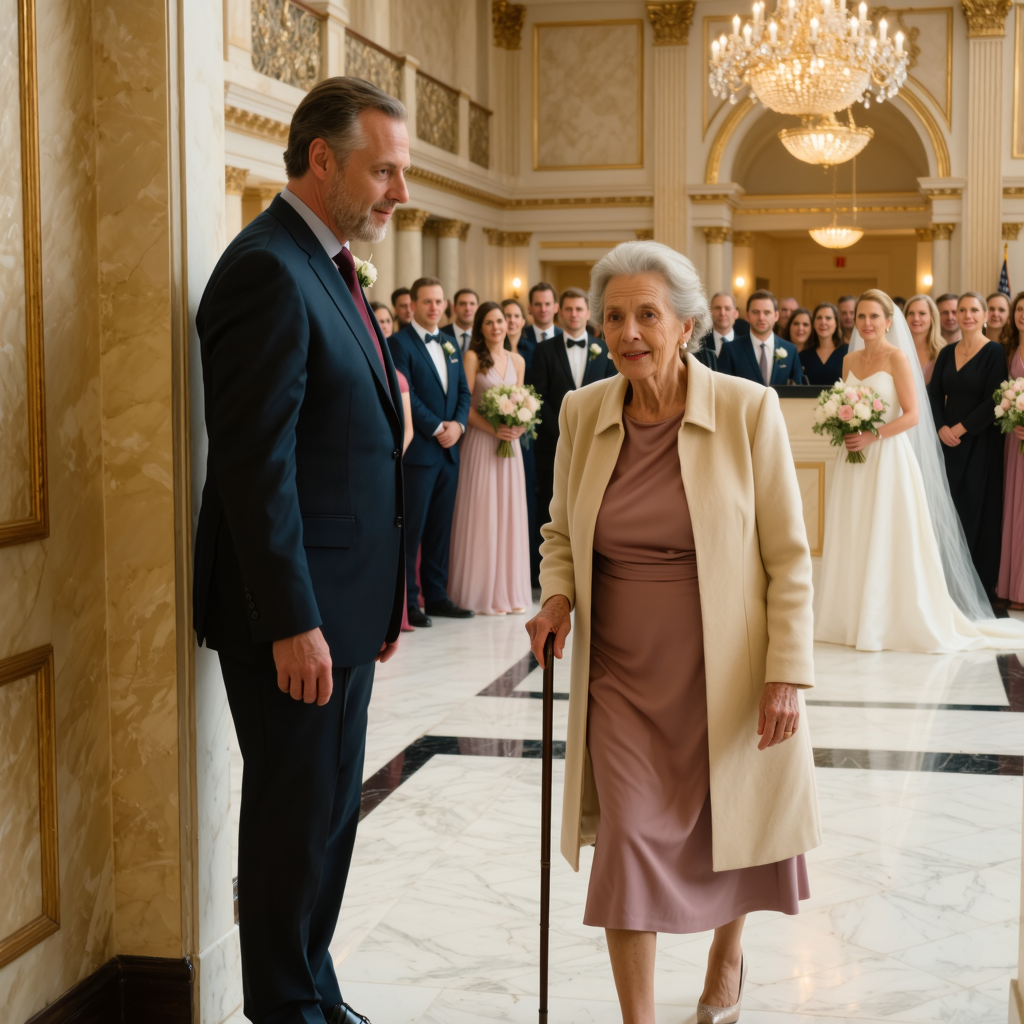
My name is Denise Parker. I am seventy-two years old, a widow, and until that evening I had still been foolish enough to believe that love, if given long enough and generously enough, would eventually be returned.
There was one small detail my son Richard and his wife Susan had forgotten when they decided to stop me at the door of my own granddaughter’s wedding: I was the one who had paid for the entire thing.
I had spent the whole morning getting ready. A granddaughter’s wedding is the kind of day a grandmother carries in her heart for years. Clara was my oldest grandchild, the first baby I ever held long enough to feel the future pressing against my chest. I still remembered changing her diapers, teaching her how to stir rice pudding without scorching the milk, laughing when she got cinnamon on her nose. Robert, my late husband, had loved rice pudding, and Clara used to call it “Grandpa’s dessert” when she was little. Now she was getting married, and I wanted to look the way a grandmother should look on a day like that—proud, elegant, happy, steady.
I chose a pink silk dress I had saved for years for some truly special occasion. I fastened my mother’s pearl necklace at my throat. I dabbed on a little French perfume I used only for holidays, weddings, and anniversaries. When I stood in front of the mirror, I did not see an old woman fading into the background. I saw someone who had lived, built, survived, loved, and earned her place in the front row of life.
I wanted Clara to see me that way too.
What I did not know was that in Richard’s eyes, I had long since stopped being a mother and become something much more convenient.
For six months, my life had revolved around that wedding. Richard and Susan came to my apartment nearly every week, sitting on my velvet couch and sipping the coffee I made while they spoke in soft, careful voices.
“You know, Mom, times are tough these days,” Richard would say.
And Susan, with that polished little smile she wore whenever money was near, would add, “We just want Clara to have her dream wedding.”
Naively, I opened both my heart and my wallet.
“How much does Clara’s dream wedding cost?” I asked.
They showed me brochures. The venue looked like an estate from a magazine. The catering menu included lobster and imported wine. The wedding gown cost as much as a small car. The flowers were to come from a designer florist in Connecticut. The string quartet had a waiting list. The whole thing was grand, theatrical, glowing with all the expensive softness people mistake for love.
And I paid every dollar of it.
More than one hundred thousand dollars.
It came from the savings Robert had left behind, the money meant to make sure I could live comfortably and help family when help was truly needed. I signed the contracts. I handled the vendors. I approved the invoices. My name was on every receipt, every wire transfer, every piece of paper that made that beautiful day possible.
That afternoon I called a cab, excited and proud. The driver was a cheerful young man with Yankees air fresheners clipped to his vents. He glanced at me in the rearview mirror and smiled.
“You look fancy, ma’am. Big party?”
I smiled back. “My granddaughter’s happiest day.”
When we arrived at Green Valley Estate, the place took my breath away. White floral arches framed the entrance. Tiny lights were woven through the trees. Soft classical music floated in the warm air. Guests were arriving in linen suits, pastel dresses, polished shoes, and careful smiles. Two hundred people—family, friends, neighbors, business acquaintances, distant relatives. They greeted me warmly, complimenting the beauty of the event.
“It’s stunning, Denise.”
“Clara looks like she’s going to have a fairy-tale wedding.”
“You must be so proud.”
I was.
I walked toward the main gate with my head high. Richard and Susan were there greeting guests. My son looked handsome in a perfectly fitted suit. Susan glittered in a bright emerald dress that caught the light at every angle.
“Richard, my son, everything looks wonderful,” I said, stepping forward to hug him.
But he did not move.
His eyes were cold. Not angry. Not embarrassed. Cold. Distant. Like the eyes of someone who had already decided I no longer belonged in the picture.
Susan turned away and fussed with a flower arrangement as if she suddenly had something more pressing to do.
“Mom,” Richard said, his voice flat, “what are you doing here?”
I laughed, because surely it had to be a joke.
“What am I doing here? I came to my granddaughter’s wedding.”
He took the guest list from the hostess stand and stared at it for a long moment. Behind me, I felt the music dim under the weight of silence. Two hundred people, all so bright and cheerful a minute earlier, seemed to go still at once.
Then Richard said, loud enough for everyone nearby to hear, “Your name isn’t on the list.”
My smile disappeared.
“What do you mean my name isn’t on the list? What kind of joke is this?”
“It’s not a joke,” he said.
Susan finally turned back, folding her hands in front of her with the expression of someone pretending to be uncomfortable while privately enjoying every second.
“Probably just some mistake in the invitation process,” Richard added.
“A mistake?” I repeated. “I paid for the invitations. I helped Susan review the list so nobody would be forgotten.”
Shame moved through me like heat. I looked at Susan. She did not speak. She just stood there with the faintest trace of satisfaction at the corners of her mouth.
Everyone was staring. My longtime neighbor covered her mouth with one hand. My nephew looked down at his phone as if the screen had suddenly become urgent. No one stepped in. No one said, Denise, this is ridiculous. No one said, Let her through. No one said, That woman paid for this wedding.
In front of two hundred people, I was treated like an intruder.
I took a slow breath. A lifetime of dignity gathered itself inside me. I would not let one ungrateful child strip it away in public.
I straightened my pearls and looked into my son’s face.
“All right, sweetheart,” I said calmly. “If I’m a mistake, I’m sorry for the inconvenience.”
Then I turned and walked away.
People moved aside as I passed. It was not the gentle, respectful kind of space you make for someone honored. It was the careful, uncertain space people make when they do not want to get involved. No one touched my arm. No one offered a word. I walked back beneath the floral arch I had paid for, listening to the music I had chosen, leaving behind the celebration I had built with my own hands.
The cab driver was still there, leaning against the car.
“Did you forget something, ma’am?” he asked.
“Yes,” I said as I got back in. “I forgot what kind of son I raised.”
The ride home was silent.
Anger and humiliation sat inside my chest like stone. They had used me. They had taken every drop of kindness I had, drained my generosity clean, and pushed me aside the minute I was no longer useful. They had wanted my money, not my presence. My son had been ashamed of his old mother. Ashamed, apparently, to let me stand in the photographs after I had funded every inch of the day.
When I got home, the apartment felt painfully quiet. The pink dress that had looked graceful in the mirror now looked foolish draped over a chair. I took it off and let it fall to the floor. My eyes drifted to the photograph of Robert on the wall.
He would never have allowed that.
He would have looked Richard dead in the eye and said, “You will not treat your mother this way.”
But Robert was gone, and all that remained was me.
I could have cried. I could have called a friend and talked until my voice wore out. I could have taken something to sleep and tried to push the whole evening into the dark. But the woman who came home that night was not the same woman who had left that afternoon.
Humiliation had woken something in me.
Before I was Richard’s mother and Clara’s grandmother, I had been Robert Parker’s partner in every sense that mattered. For ten years after his death, I ran his logistics company myself. I managed finances, negotiated contracts, handled employees, solved problems, and learned the value of every dollar down to the cent. I knew exactly how power moved through a room, and I knew exactly what people revealed when they thought a woman had grown too old to be dangerous.
I did not cry.
I walked straight into my office, opened the file cabinet, and pulled out a cream-colored folder labeled Clara’s wedding.
Inside was everything. The venue contract with my signature. Catering invoices in my name. Decoration receipts. Payment confirmations. Wire transfers from my account to every vendor.
Then I picked up the phone.
My lawyer, Martin Hayes, had been my legal adviser for thirty years. He answered on the second ring.
“Mrs. Parker,” he said warmly, “what a coincidence. Today’s your granddaughter’s big day, isn’t it?”
I smiled, but there was no joy in it.
“Martin, I need the best attorney you can be tomorrow morning. Do you have five minutes?”
“I have the whole evening. What happened?”
I sat down in my leather chair, opened the folder in front of me, and said slowly, “I was asked to leave the wedding I paid for.”
Silence.
Then Martin asked, in a very different voice, “Tell me everything.”
“My son and daughter-in-law think they can take my money and treat me like I don’t matter,” I said. “I need you to help me fix that.”
By the time I hung up, the pain was still raw and the humiliation still burning, but underneath it something sharper had formed. Richard thought he had shut me out of a party. What he did not know was that he had just closed the door on the easy life he had been living at my expense.
The next morning, instead of an apology, he was going to receive consequences.
I did not sleep that night. The pink dress lay on the floor like a shed skin. The old clock in the living room ticked steadily in the dark. Morning came pale and quiet, and for once I did not make coffee. Even the smell would have felt bitter.
At nine o’clock the doorbell rang.
Martin stood there, coat over one arm, briefcase in hand. He had been part of our lives so long he was practically family. He was Richard’s godfather. When he saw my face, he froze, and anger flickered through his expression.
“Good Lord, Denise.”
“I’m fine,” I said. “The files are on the table.”
He sat down and began reading. I stood by the window, looking out at a bright, ordinary American morning—kids on bikes, a dog walker in a baseball cap, a delivery truck idling by the curb. The kind of morning on which I should have been eating post-wedding brunch in a hotel banquet room, listening to Clara laugh and showing off photographs from the ceremony.
“Denise,” Martin said at last, “everything is in your name. The contracts, the receipts, the transfers. Legally, you were the event owner. The host.”
I let out a bitter laugh. “The host. Locked out of her own party.”
“It’s more than ironic,” he said grimly. “It’s humiliating.”
We were both thinking of Richard.
“What do you want to do?” Martin asked. “We can sue for emotional damages. You have two hundred witnesses.”
I turned from the window. “Martin, what do you think I want? An apology? A check written with my own money?”
He said nothing.
And that was when the truth sharpened into something I could finally name.
The wound was not just humiliation. It was power.
They had never seen me as a mother or a grandmother. To them I had become a wallet that never ran dry. And when people no longer need the wallet, they close it. In Richard’s case, he locked it out of the wedding so it would not spoil the family photographs.
I began remembering things I had let pass over the years, all the little moments that had seemed rude but small at the time.
“Mom, you don’t understand real estate investments,” Richard once told me when I advised him to buy a rental property instead of another luxury car.
“Mrs. Parker, this phone is too complicated for you,” Susan had said with sweet, patronizing patience when I asked about the banking app.
Neither of them had any idea that after Robert died, I had handled freight contracts, union negotiations, payroll, operating costs, taxes, and acquisitions. I had sold the company five years earlier for a fortune. Richard and Susan thought it was ordinary retirement money. They thought the one hundred thousand dollars for Clara’s wedding had been some enormous sacrifice.
The truth was worse than that.
I realized I had not been treated like family for years.
I had been the nice mother. The free babysitter when they wanted date nights. The one who signed checks for college tuition. The one who covered Susan’s credit card “just this once.” The one who always stepped in quietly so nobody else had to feel discomfort.
I was not family.
I was a function.
“Keep the wedding file,” I told Martin. “It’s proof, but it’s not the weapon.”
He frowned. “Denise, what are you planning?”
“Where are Richard and Susan now?”
“They left for their honeymoon, didn’t they? Paris, I think. Clara mentioned it.”
“Good,” I said. “Let them enjoy fifteen lovely days.”
Then I walked into Robert’s old office, opened the safe, and brought back a blue folder.
I laid it in front of Martin.
“This,” I said, “is rediscovered power.”
Inside were two property deeds.
The first was for the apartment where Richard and Susan lived—three bedrooms, large balcony, full-service building, underground garage.
Martin looked up at me, startled. “Everything’s in your name.”
“Of course. I bought it as an investment. Richard said rent was too high and the children needed more room. I let them live there. No lease. No rent. No property fees. No building fees. I paid all of it.”
He swallowed. “And the second deed?”
“The beach house. The one they photograph every summer and post online with captions about family time and gratitude. That’s mine too.”
I let that sit for a moment before continuing.
“And in my garage there’s a gray car Richard drives around as if it belongs to him. He calls it his company car. That company used to be mine. I sold the business, but the vehicles remained under my name. Insurance, registration, taxes—everything.”
Martin leaned back slowly, like a general studying a battle map.
“Denise Parker,” he said quietly, “what exactly do you want me to do?”
I began to pace, and with every step the fog in my mind cleared.
“They erased my name from the guest list,” I said. “Now it’s my turn.”
I counted it off on my fingers.
“First, the apartment. I want a formal eviction notice. When they land back from Paris, I want it waiting for them. Posted on the door. Thirty days to move out. That’s what the law says, right?”
“That’s what the law says.”
“If it were up to my feelings, I’d give them thirty minutes. But we will do everything properly.”
He nodded.
“Second, the beach house. Change the locks. Hire a security company. If they try to enter, it will be treated as trespassing.”
“All right.”
“Third, the car. Send a registered letter demanding its immediate return. If they refuse, we proceed accordingly.”
I stopped, opened my purse, took out my phone, and pulled up the banking app Susan once claimed I could not handle.
There it was.
Scheduled transfer: Richard Parker. Four thousand dollars monthly.
I turned the screen toward Martin.
He let out a low whistle. “You send them four thousand dollars every month?”
“The allowance, as they call it. Susan doesn’t work. She calls herself an influencer. Richard’s salary from that tiny ad agency barely covers his suits.”
Then, with one calm touch, I canceled the transfer.
The screen blinked.
Scheduled transfer canceled.
“Done,” I said.
Martin was quiet for a long moment. When he finally looked at me again, there was no pity left in his face. Only respect.
“They’re going to hate you, Denise.”
“They already do,” I said. “They’ve only hidden it well because they needed my money. They don’t resent me for being cruel. They resent me for being old. They resent me because I remind them they are not nearly as secure as they pretend to be.”
“And Clara?” he asked softly.
That was the one that still hurt.
“She knew I paid for her dress. She knew I was turned away at the door, and she said nothing. She chose the party. She chose her parents. She chose comfort. Now she can live with that choice without my protection.”
I drew a steadying breath.
“Martin, we spend our whole lives watering certain trees because we planted them ourselves. But when one grows crooked and keeps bearing bitterness, there comes a day you have to stop pretending it is healthy.”
He closed the blue folder and slipped it into his briefcase.
“I’ll prepare the notices today,” he said. “By the time they return, everything will be in motion.”
At the door he paused.
“Will you be all right?”
I looked at Robert’s smiling photograph on the wall.
“I’ll be better than all right. Last night I felt like a mistake. Today I feel like a beginning.”
After he left, the house was quiet, but it was not the silence of defeat. It was the silence that comes before strategy unfolds. My son and daughter-in-law were somewhere over the Atlantic, sipping champagne and congratulating themselves for outmaneuvering a sentimental old woman.
They were flying toward the City of Light.
They had no idea that when they came home, every light in their comfortable little world would start going out.
The next fifteen days were some of the strangest and clearest of my life. While Richard and Susan were in Paris eating cheese, taking photographs, and walking past designer windows, I was in New York dismantling the scaffolding of privilege they had mistaken for permanent security.
Everything moved quietly and precisely.
On the first day Martin called. “The beach house locks have been changed. Security will be there around the clock.”
“Good,” I said. “Send me the invoices and the new keys.”
Then I handled my own business.
The pink dress still lay where I had dropped it. I picked it up, sat down with a pair of scissors, and cut it apart piece by piece. Not in anger exactly. In finality. When I was done, I tied the pieces into a garbage bag and took them down the service elevator myself.
Then I cleaned.
I went into the guest room Richard and Susan liked to call “their room” whenever they stayed over. I removed the expensive sheets Susan had insisted I buy, the fluffy towels, the decorative candles, the extra throw blanket, all the little things that had turned my home into a free extension of theirs. I boxed some up, donated some, and put the rest away. By evening the room had become what it was supposed to be: just a room in my home.
In the living room, I came across last Christmas’s framed family photo. Richard smiling confidently. Susan polished and pleased. Clara leaning toward her mother. Me in the corner, hands folded, looking tired but grateful to be included. I studied Susan’s smile in that picture and realized it was the same one she had worn at the wedding entrance.
I put the frame in a drawer.
In its place, I set another photograph: Robert and me on the day we opened Parker Logistics. We were younger then, standing in front of a warehouse with grease on our hands and sunlight in our eyes, looking like people who fully expected to build something from nothing.
“It’s done, Robert,” I whispered. “The house is clean again.”
A week passed. Then came the first of the month.
The day I usually sent Richard four thousand dollars.
I got up early, brewed strong coffee, and sat in my armchair as the city woke around me. Somewhere in Paris, Susan was probably strolling into another boutique, handing over a card with the lazy confidence of a woman who had never had to wonder where the money came from. Richard was probably in some café ordering breakfast as if the world owed him convenience.
I pictured the clerk running Susan’s card once, then again.
“Sorry, ma’am. It’s been declined.”
I imagined the confusion hardening into panic. I imagined Richard’s face tightening as his own card failed too. The first crack in a life built on my quiet support.
They did not call that day.
But by evening, a message appeared on the old phone I had kept specifically so I could watch without responding.
Mom, are you okay? The money didn’t go through. Did something happen?
Not, Mom, are you hurt after what happened at the wedding?
Not, Mom, we are sorry.
Just: Where is the money?
My fingers itched to reply. To tell him what I thought of his concern. But by then I understood something he did not.
Silence is often sharper than speech.
So I deleted the message.
While they sat in Paris staring at empty balances and growing unease, I moved forward.
Martin called again. “The eviction notice has been filed. The posting is set for the day they return. The retrieval letter for the vehicle has been sent to the apartment. The doorman has instructions.”
I felt lighter every time another thread was cut.
And something else began to happen in those days: I remembered myself.
I went to the salon and had my hair cut shorter, cleaner, more modern—the sort of style Susan once told me only younger women could carry off. I had the gray toned down into a soft light brown that brightened my face without pretending I was thirty. I went to the mall, not to buy gifts, not to shop for grandchildren, not to refill a household somebody else benefited from. I bought myself a laptop. Then I hired a young tutor for private lessons.
“I want to learn everything,” I told him. “Spreadsheets, investments, financial apps, all of it.”
Susan thought I couldn’t manage a phone. Within a week I had moved most of my liquid assets into secure instruments Richard knew nothing about. I opened a new digital account accessible only to me. In the old account—the one he was familiar with—I left a little money and nothing more. Enough to avoid nuisance. Not enough to be worth chasing.
For the first time in years, my finances felt protected from family.
The day before Richard and Susan were due back, I did something else I had not done in a long time.
I drove myself out to the beach house.
It sat exactly where it always had, near the water, quiet and broad-shouldered beneath a bright sky. Martin had sent the new keys by courier. When I opened the door, the house was still. No trace of Susan’s sugary perfume. No imported beer shoved into the fridge. No scattered sandals in the entryway. No evidence of people who used other people’s property as scenery.
It was mine again.
I sat on the porch and looked out at the water. The ocean was calm, pale blue, and endlessly patient. I cried then, but not out of pain. Out of relief. I cried for the woman who had let herself be used so long she had mistaken exhaustion for love. I cried for Robert because I had allowed his son to become the sort of man who could humiliate his mother in public and still expect a direct deposit on the first of the month.
“It’s over now, Robert,” I said into the wind. “From now on, I decide what stays and what goes.”
I spent the night there and drove back Sunday morning, the same day their flight landed.
I knew the plane from Paris was due in New York in the afternoon. Customs, baggage claim, traffic—if all went normally, they would reach the apartment around eight in the evening.
I took a salt bath, put on silk pajamas, brewed chamomile tea, and sat in my armchair facing the landline.
At 8:15, the phone rang.
Richard.
I let it ring several times before answering.
“Hello,” I said in the calmest voice I could manage.
The shouting on the other end was so loud I had to pull the receiver away.
“Mom, what is this? Are you out of your mind? Did you throw us out of the apartment?”
Behind him I could hear Susan’s shrill voice rising and falling. I waited for the noise to taper.
“Richard,” I said evenly, “lower your voice. I am not deaf. What are you talking about?”
“There’s a notice taped to the door. Thirty days. Eviction. This is some kind of joke, right?”
“Oh, that,” I said. “No, darling. It isn’t a joke. It’s a legal notice.”
“Legal notice? You’re putting your own son out on the street?”
“No,” I said. “I’m reclaiming my property. That apartment belongs to me. You will need to find somewhere else to live.”
There was a stunned silence.
Then he tried a different tone, the softer one he used whenever he wanted something.
“This is about the wedding, isn’t it? Mom, it was a misunderstanding. Susan was stressed. There was a mix-up with the list.”
I cut him off.
“A mix-up? The invitations I paid for? The list I reviewed myself? You looked your mother in the eye and told me I wasn’t on it. You turned me away from a celebration I funded.”
“Mom, please—”
“You and your wife made me the object of a public scene. And now I understand.”
“Understand what?”
“That I no longer have a family in the way I thought I did. I have a son and a daughter-in-law who grew very comfortable living on my money, in my apartment, driving my car, while pretending respect.”
“That’s not fair,” Susan snapped, grabbing the phone. “We love you.”
“You love what I provided,” I said. “That’s different.”
Richard got back on the line, panic breaking through his anger now.
“What about the transfer? It stopped. Why did it stop?”
“I’m seventy-two, Richard. Older people have expenses too. Medical bills. Insurance. Life. I need my money to support myself.”
“And the car?”
“I need to sell it.”
“That’s my car. I need it for work.”
“Then perhaps work can support you,” I said. “Besides, you have thirty days to leave my apartment.”
That was when he exploded fully. Threats, insults, legal bluster, even the suggestion that he could claim I was mentally unfit and try to gain control of my assets.
I laughed. A short, dry laugh.
“Go ahead,” I said. “Good lawyers are expensive, and like I said, your money’s gone. Martin, however, is very well paid and very motivated.”
I took one last breath and spoke as clearly as I ever had in my life.
“You blocked me at the door by mistake, Richard. I blocked you by choice. You have thirty days. The clock started the moment you read that notice. Good night, and welcome home from your honeymoon.”
Then I hung up.
The room fell into the most beautiful silence I had ever known.
My house no longer felt too big or too empty. It felt proportionate to peace.
The phone rang again and again. I let it. Then I unplugged it.
That night I slept eight full hours without a single dream.
The next morning sunlight poured through the windows. I made strong coffee, the kind Robert used to say could wake the dead, and checked the old phone.
Thirty-seven messages.
The first few begged.
Mom, please pick up. This was a misunderstanding. Let’s talk.
Then the tone shifted.
You’re ruining your son’s life.
Susan collapsed.
If anything happens to her, it’s on you.
Then negotiation.
How much do you want to stop this?
Half the apartment is mine by inheritance.
I laughed aloud at that one. Inheritance. I was very much alive.
I deleted them all, grabbed my bag, and headed to my computer class.
While I was learning Excel and discovering, to my quiet satisfaction, that I was quite good at it, Richard decided to prove that he was still in control. He put on one of the expensive suits bought with my support, went down to the garage, and tried to drive away in the gray car I had already reclaimed on paper.
What he had not expected was a doorman with instructions.
Mr. George was standing by the booth when Richard approached.
“Good morning, Mr. Richard. Welcome back,” he said politely.
“Morning. Open the gate. I’m in a hurry.”
Richard pressed the key fob. The car beeped. The gate stayed closed.
“George,” Richard said more sharply, “open the gate.”
George stepped forward, visibly uncomfortable but firm.
“I’m sorry, sir, but I have direct orders from the owner, Mrs. Denise Parker. This vehicle has been listed as an asset to be reclaimed. Insurance has been notified. If anyone attempts to remove it without authorization, I am required to report it.”
Richard froze.
“What are you talking about?”
“The vehicle is not registered in your name, sir.”
Later I heard the entire story from my neighbor Martha, who had been walking her terrier across the street and saw the scene unfold from beginning to end.
Susan, she said, came rushing down in oversized sunglasses and called George every polished insult she could think of. Richard turned red, yanked the child seat out of the back, tossed a few personal items onto the garage floor, and stormed off to hail a cab.
Public embarrassment.
Not as grand as what they had done to me at the wedding, but visible enough to sting.
That same afternoon Susan discovered another consequence. She tried to order lunch. Her card was declined. She tried another. Declined. Then Richard’s. Same result.
The four thousand dollars I had sent every month was not pocket money. It was the cushion beneath their entire life.
And I had pulled it away.
They could not spend. They could not drive. They could not reach me. So eventually they did the only thing left.
They came to find me.
That afternoon I had just left my computer lesson, laptop in my tote bag, when I reached the entrance of my building and saw them waiting outside.
Richard and Susan looked nothing like the polished couple from the wedding.
Susan’s hair was unbrushed, her makeup streaked. Richard’s face was twisted by a kind of anger so naked and helpless it almost made him look unfamiliar.
“Mom!” he shouted, rushing toward me.
I stopped where I was. My doorman, Patrick, straightened immediately, ready to intervene, but I gave him a small wave to hold back.
“Richard. Susan. What a surprise.”
“Open the door,” Richard snapped. “We need to talk.”
He reached for my arm. I stepped back.
“I have nothing to say, and you are not coming into my home.”
“You can’t do this. I’m your son. I live here.”
“No, Richard. You have lived in my apartment for ten years without paying for it. There is a difference.”
Susan stepped forward, hands clasped dramatically.
“Mrs. Denise, please don’t be harsh. We were wrong. We’re sorry. It was the receptionist’s mistake. She mixed up the list.”
I looked straight at her.
“Susan, that performance is beneath even you. You were checking that list yourself. You stood there and watched my son turn me away, and you smiled.”
She went pale.
Richard changed tactics again, leaning into threat.
“You’re going to regret this. You’re old. You’re confused. I’ll take this to court. I’ll prove you can’t manage your own finances.”
I stared at the man I had once carried in my body and raised with my own hands.
Then I laughed.
“Confused, Richard? Let me show you something.”
I pulled out my phone, opened the banking app, and held it up.
“See this? The same app Susan said was too complicated for me. This morning I bought shares in two major corporations and rebalanced an investment account. What exactly did you do today besides spend energy on trying to frighten me?”
My voice no longer sounded old, even to me. It sounded exact.
“You want to sue me? Please do. But legal fees cost money, and you don’t have any. And since you seem so concerned about my mental fitness, you should know I already had a full professional evaluation last week. Martin has a copy. Any judge who sees it will understand very quickly what this is.”
Richard’s face changed color.
They had forgotten who I was.
They thought I was just a faucet they could turn on whenever they needed cash. They had forgotten who built the plumbing.
I looked from him to Susan.
“That three-bedroom apartment you’re desperate to keep, the car you’re trying to drive, the monthly allowance you depended on—none of that was my fortune. It was barely a ripple in it.”
They stared.
“You thought I sold Robert’s company and lived off ordinary retirement money? No. I sold the trucking operation, yes, but I kept the warehouses. Six of them. One leased to Amazon. One to FedEx. One to a pharmaceutical company. Do you know how much rent those properties generate every month?”
Neither of them spoke.
“The one hundred thousand dollars I paid for Clara’s wedding?” I said. “That is about what I pay in annual property taxes. I gave it out of love. You threw it back in my face.”
Susan’s mouth opened slightly. Richard looked ten years older in the space of ten seconds.
“You underestimated me,” I said. “That was your greatest mistake.”
Then I turned to Patrick.
“Please call security. They are not welcome on the premises.”
“Wait, Mom—” Richard shouted, real panic breaking through.
I looked back at him with a calm I had earned the hard way.
“Do not call me that. You gave up that privilege at the wedding entrance.”
Then I walked through the glass doors of my building without looking back.
As the elevator rose, my phone rang again. Unknown number.
I answered.
“Hello, Grandma,” Clara said, her voice trembling.
For one small, painful second, my heart softened.
“Clara,” I said. “What a surprise. How was Paris? Was the wedding beautiful?”
She started crying.
“Grandma, what’s happening? Mom and Dad said you lost your mind and threw them out of their home.”
I closed my eyes.
“I have not lost my mind, Clara. I’ve never been more clear. I am simply taking back what belongs to me.”
“But is this because of the wedding?” she asked. “I swear I didn’t understand what was happening. It all happened so fast. I was nervous.”
“You didn’t understand?” I repeated softly. “You didn’t notice that your grandmother—the one who raised you half your childhood while your parents were busy—was missing from the ceremony she paid for? You didn’t notice the empty chair in the front row?”
Her breath caught.
“I was humiliated in front of two hundred people, Clara. Your father turned me away like I was nothing. You stood there and got married. Then you flew to Paris for fifteen days and never once called to ask whether I was all right.”
She was crying openly now.
“Grandma, please—”
“You’re only calling because your parents ran out of money,” I said. “That is the truth.”
Silence.
Then a small, broken sound on the line.
“Your parents chose their path,” I said more quietly. “And by your silence, you chose too. I still love you, Clara. But the version of me that paid for everything and endured everything is gone. She ended at the door of your wedding.”
Then I ended the call.
The elevator doors opened.
When I stepped into my apartment, the balance of power had not merely shifted. It had been carved into place.
The thirty days I gave Richard and Susan passed quickly for me and, I suspect, like a slow collapse for them.
They stopped calling directly after a while. Apparently, they found a lawyer willing to listen, though not, in the end, one willing to take their fantasy too seriously.
Martin phoned me one afternoon, laughing under his breath.
“I just got a call from a colleague,” he said. “Richard and Susan wanted him to negotiate some kind of settlement.”
“What did you tell him?”
“That Denise Parker does not negotiate with people who publicly cast her aside and then demand comfort. The only agreement available is this: hand over the keys by day thirty, or face formal eviction.”
“And?”
“He went very quiet. I suspect they left out important details.”
“They always do,” I said.
“And the car has been returned. Richard hired a tow truck to deliver it to my office garage.”
I smiled. “At least he used proper procedure for once.”
On the thirtieth day, a courier arrived with a brown envelope.
Inside were the apartment keys and the beach house keys.
No note. No apology. No explanation. Just surrender.
I held them in my palm and felt not victory exactly, but clarity. The weight of metal. The weight of consequence.
Martha, my neighbor with the best unofficial intelligence network on the Upper West Side, told me Richard and Susan could not afford a hotel for long and had wound up in a cramped one-bedroom rental in the suburbs, financed by a modest loan Richard barely qualified for. Susan, whose social posts had once featured curated handbags and sponsored brunches, was quietly selling off accessories she had once flashed as proof of status.
They had not learned remorse. I do not think either of them had the temperament for it. What they learned was dependency. They learned that the money they worshiped had never belonged to them. And once it stopped flowing, the performance of certainty fell apart.
Richard started taking the bus. Susan began shopping in discount stores.
But the greatest change was not in them.
It was in me.
I sold the apartment within a week for more than expected. This time I did not leave the money sitting idle. Using everything I had sharpened in those computer lessons, I began investing more actively. Not recklessly—Robert would never forgive that—but intelligently, with structure, purpose, and room for growth.
I enrolled in the Italian class I had always wanted to take.
“Buongiorno,” my teacher Lorenzo would say with a grin every Thursday evening, and I would answer with the determination of a woman proving to herself that there is no age at which reinvention becomes foolish.
I revived another dream too—one Robert and I had once talked about in the early years, when business was growing and our weekends were still our own. We had wanted to build a small rescue for abandoned dogs and cats, a place simple and clean where creatures nobody wanted could still be safe.
With part of the money from the apartment sale, I bought a modest piece of land outside the city and started construction. Martin volunteered to handle the paperwork at no charge. He said it was the most meaningful legal work he had done in years.
My home, once so quiet it had echoed, slowly filled with new sounds. New routines. New purpose. Neighbors who had once looked at me with polite widow-sympathy now looked at me with something closer to admiration.
One afternoon in the elevator, Martha squeezed my hand and said, “Denise, you didn’t just do this for yourself. You did it for every woman who has spent years being expected to stay silent.”
I smiled, though the truth was more private than that.
I had done it for myself.
But sometimes when a woman finally refuses to disappear, other women notice.
As for Clara, that wound remained open much longer than the others.
She did not call again for nearly two months.
Then one afternoon, the doorbell rang.
I looked through the peephole and felt my chest tighten.
It was her.
She looked thinner. Smaller somehow. No designer clothes, no polished bridal glow, no expensive luggage set at her feet. Just jeans, a T-shirt, and the hollow, stunned face of someone who had discovered too late that appearances can collapse faster than vows.
I opened the door.
We looked at each other for a long moment.
Then she began to cry.
“Grandma,” she whispered.
“Come in, Clara.”
She sat on the same sofa where her parents had once asked me for wedding money.
“Grandma,” she said after several minutes of trying to steady herself, “I’m divorced.”
I was not surprised.
“What happened, sweetheart?”
“Money,” she said. “When the money disappeared, everything changed. Michael… he didn’t marry me because he loved me. He married me because I was Denise Parker’s granddaughter. When he realized Mom and Dad had nothing left, he changed. He became resentful. Hard. He said he wasn’t going to carry a whole family that had nothing.”
Tears rolled down her face.
And suddenly the pattern, so ugly and familiar, was complete.
I went into the kitchen and made chamomile tea with honey, the same way I used to when she was little and had nightmares.
I handed her the cup. Her fingers trembled around it.
“What about your parents?” I asked.
She stared down at the tea.
“They haven’t changed. Mom cries and blames Dad. Dad blames you. Neither of them asked how I was. They only wanted to know whether I had talked to you. Whether I had apologized for them.”
She looked up then, red-eyed and ashamed.
“They don’t regret what happened at the wedding,” she said. “They only regret losing everything after.”
I said nothing.
“Grandma,” she whispered, “I know I was wrong. I saw what happened. I saw Dad stop you. I did nothing because I was scared. Scared of ruining the wedding. Scared Mom would make a scene. I was cowardly. And I understand now why you did what you did.”
I sat beside her and took her hand.
“You know, Clara,” I said gently, “women like us are taught from the very beginning to smooth things over. To keep the peace. To smile when we’re hurt. To call it dignity when really it’s fear. They tell us that getting older means becoming softer and quieter, as if self-respect has an expiration date.”
She listened without moving.
“But dignity has no age,” I said. “It doesn’t disappear when your hair changes color. It doesn’t vanish because someone younger decides you are inconvenient. What I did was not revenge for the sake of revenge. It was protection. I protected myself because no one else there was willing to do it.”
She squeezed my hand weakly.
“I don’t have anywhere to go,” she admitted. “Michael told me to leave. I can’t go back to my parents.”
I looked toward the hallway. Toward the guest room I had reclaimed and restored.
“The room at the end of the hall is still there,” I said. “And it will always be yours if you are willing to live honestly in it.”
Clara did not become spoiled again, and I did not return to old patterns. I did not hand her money or rescue her with another check. I gave her something harder and better. I gave her shelter, a computer, internet access, and the expectation that she would use them well.
She turned out to have real talent for design. She started freelancing. Slowly, carefully, she began paying the utility bills and some groceries. It was not dramatic. It was not glamorous. It was something much more durable.
Independence.
And that, more than anything, completed my transformation.
Not because I defeated my son, but because I finally stopped abandoning myself in order to keep other people comfortable.
Today I manage six warehouses, an animal rescue center, and a portfolio I understand better than Richard ever imagined. I speak enough Italian to order dinner and flirt mildly with my teacher. I invest. I travel occasionally. I sleep well.
Richard and Susan never truly came back into my life. Martin once told me they made a brief, pathetic attempt to file something against me, hoping to paint me as neglectful and unstable, but it went nowhere. A judge dismissed it almost immediately.
Now they are little more than a faded mark on the edge of a chapter I no longer live inside.
When I think back to that night—the pink dress, the pearls, the string music drifting through the trees, my own son telling me I did not belong—I no longer feel shame.
I feel gratitude.
Because the moment I was turned away from the wedding I paid for was the same moment I was finally invited back into my own life.
And this is one celebration no one will ever be allowed to keep me out of again.