A Dollar He Never Got to Ask For Twice
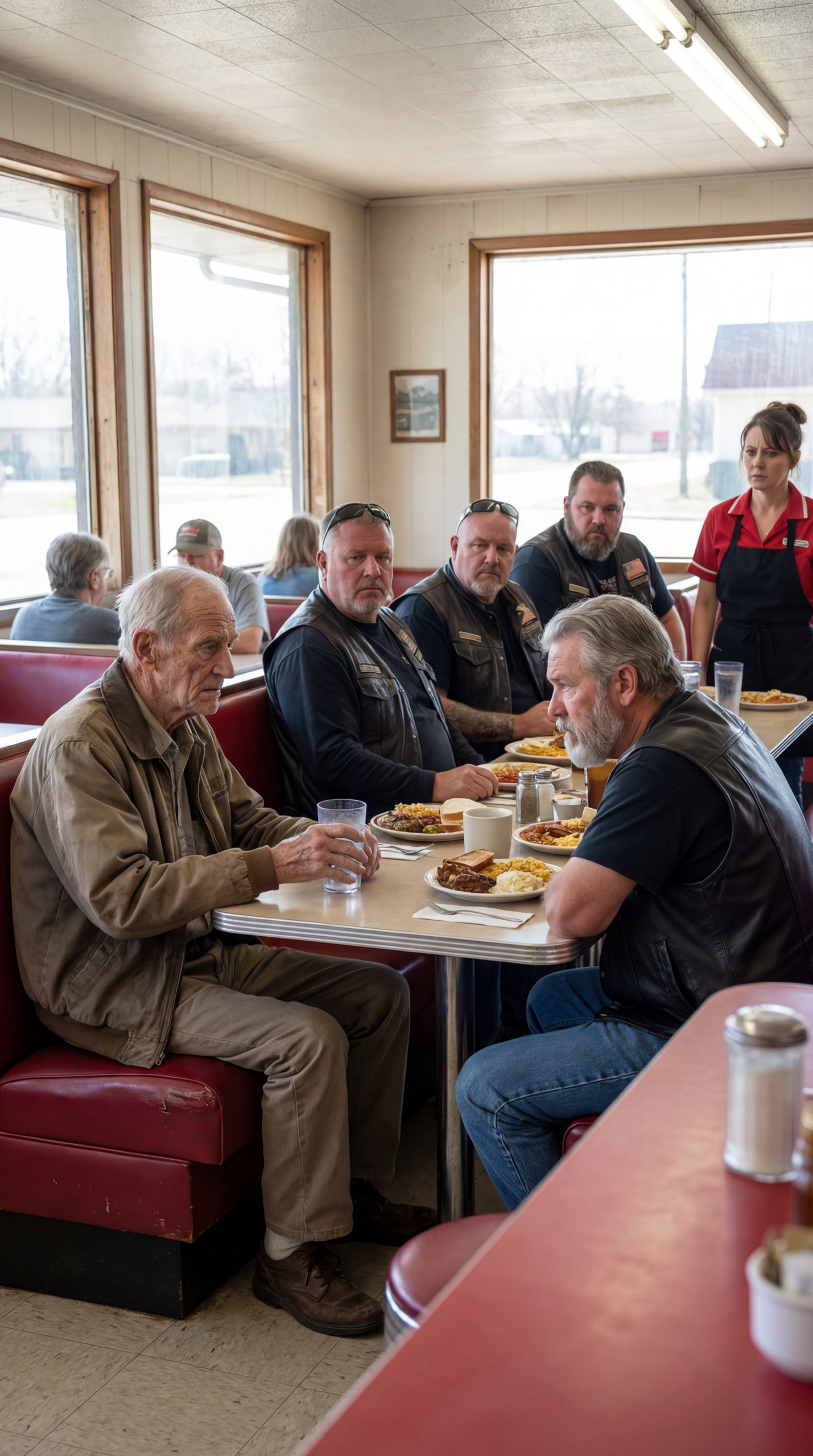
The old diner on Maple Run Road had been part of Cedar Hollow, Missouri, for so long that people barely noticed it anymore. It sat near the highway with a weathered sign, foggy front windows, and a bell above the door that gave the same tired ring every time someone walked in. The booths were cracked. The coffee was strong. The floor always smelled faintly of bacon, toast, and old winter air.
For most people, it was just a place to stop before work or on the way to somewhere else.
For eighty-five-year-old Walter Kincaid, it had become the one place where he could sit without feeling like he was in the way.
That Thursday morning was bitterly cold. The kind of cold that found its way through coat sleeves, under collars, and into old bones that had already carried too much. Walter sat alone in a corner booth with both hands wrapped around a glass of water. He had not ordered breakfast. He had not ordered coffee. He had not ordered anything at all.
He told himself it was enough just to be warm for a little while.
But the truth sat across from him like an unwelcome companion. He was hungry. Not the kind of hunger a person could laugh off until lunch. This was the kind that made his hands shake and pulled the strength from his back and shoulders. His cheeks had grown hollow over the past few months. The sleeves of his jacket hung loose. Even lifting the glass took more effort than it should have.
He kept his eyes low, pretending to study the water slipping down the side of the glass.
At the counter, the waitress had already noticed.
Tessa Bell had worked at the diner for almost twelve years. She noticed everything. She noticed which truckers preferred extra jam, which couples were no longer speaking to each other, and which regulars were trying to hide pain behind polite smiles. Walter had been coming in every Tuesday and Thursday for nearly two years. He always arrived a little after ten. He always sat in the same booth. And lately, he had stopped ordering.
Tessa had seen the change happen slowly.
First he stopped asking for eggs.
Then he switched to toast.
Then just coffee.
Now only water.
She wanted to bring him food without making him feel small, but Walter Kincaid carried his pride the way some men carried medals. Carefully. Silently. Close to the chest.
He had earned that pride a lifetime ago.
Walter had served in Korea when he was barely more than a boy. He had survived frozen nights, fear that never fully left the body, and the kind of losses a man learned to carry without speaking about them. There were years when he spoke almost nothing about the war, but the memories had settled into him anyway. They showed in the way he stared at snow. In the way loud sounds still made his shoulders tense. In the way he never wasted food when he had it.
He had faced hard winters before. He had known hunger in places no one should. But those years had come with purpose, duty, and brothers beside him.
This hunger felt different.
This hunger came with shame.
The Men Everyone Watched

A low vibration rolled through the diner’s windows before anyone saw the motorcycles.
Tessa looked up first. Then the truck driver near the door. Then the young couple by the window. One by one, every face turned toward the parking lot as five large motorcycles pulled in and parked side by side beneath the weak morning light.
The engines cut off, but the tension stayed behind.
The men who stepped inside wore leather vests, worn boots, heavy rings, and the kind of expressions that made rooms go quiet. They looked like men who had lived hard lives and expected not to be questioned. Their presence changed the air before they even said a word.
Conversations stopped. Forks paused halfway to mouths. Even the bell above the door seemed sharper than usual when it rang.
Walter looked up slowly and felt his stomach tighten.
The five bikers moved toward the back of the diner after ordering breakfast, and for one uneasy second Walter thought they might pass him by.
They did not.
Their leader was a broad-shouldered man with a gray beard and deep lines around his eyes. He carried himself with calm authority, not the kind that needed raised voices. The patch on his vest marked him as someone the others followed. He glanced at Walter once, then at the empty table, then at the trembling hand around the glass.
He and his friends sat in the booth beside Walter’s.
Soon plates arrived. Steak. Eggs. Potatoes. Toast. Bacon. Fresh coffee.
The smell hit Walter so suddenly it almost made him dizzy.
He looked away at once, embarrassed by how quickly his body reacted. His stomach tightened with such force that he pressed one hand against it under the table. He hated that anyone might notice. Hated even more that someone probably already had.
For several long minutes, all he heard was the scrape of forks, the murmur of boots shifting beneath the table, the hum of the lights overhead, and his own thoughts arguing with each other.
Don’t ask.
You have to ask.
Not them.
Why not them?
You’ve made it this far.
You won’t make it through the day.
His fingers curled tighter around the glass.
Then he looked down at his own hands, thin and unsteady, and knew there was no dignity left in pretending.
He turned slightly toward the bearded man and cleared his throat, though the sound came out weaker than he meant it to.
“Sir… I’m sorry to bother you.”
The man looked at him without annoyance. Just steady attention.
Walter swallowed.
“Could you spare a dollar?”
The Silence After the Question
The diner fell so quiet it seemed the walls themselves had stopped breathing.
Tessa stood frozen beside the coffee machine.
The trucker by the window lowered his fork.
The young couple stopped moving altogether.
Walter wished, for one terrible second, that he could take the words back. He had never imagined his life would narrow to this moment. A man who had once stood in uniform for his country was now asking a stranger for a single dollar so he could maybe buy enough to settle the ache in his stomach.
He stared at the table, waiting for the refusal.
The bearded biker did not answer right away.
His eyes moved over Walter slowly, reading what the old man had not said. The worn coat. The faded collar. The posture of someone trying very hard not to collapse inward. And then, just barely visible beneath Walter’s sleeve, a weathered military tattoo from long ago.
The biker set down his fork.
Then he leaned back and spoke in a voice that was deep, controlled, and impossible to mistake.
“You don’t need a dollar.”
Walter’s face burned.
He started to nod, already ashamed.
But the man continued.
“You need breakfast.”
Walter looked up, unsure he had heard correctly.
The biker slid his own plate toward the middle of the table and nodded to the empty seat across from him.
“Come sit with us, old soldier.”
Walter blinked. “I… I couldn’t.”
One of the other bikers, a dark-haired man with tired eyes and a soft expression, pushed the coffee pot closer.
“Yes, you can.”
The bearded man pointed gently toward the seat.
“Sit down. Eat while it’s hot.”
Walter moved as if in a dream. His legs felt weak. His hands shook worse than before, not from fear now, but from the sudden strain of holding back emotion. He slid into the booth across from them, his shoulders stiff with disbelief.
No one laughed. No one made a joke. No one treated him like a burden.
They simply made room.
Walter picked up the fork with trembling fingers and cut a small piece of steak. The first bite nearly undid him. He kept chewing because stopping would have meant crying, and he had spent most of his life learning how not to do that in front of other men.
But one tear escaped anyway and ran quietly down the side of his face.
No one called attention to it.
They let him eat in peace.
A Name Worth Respecting
By the time the plate was half empty, warmth had returned to Walter’s hands. His breathing had steadied. The hard hollow ache in his stomach had softened enough for him to think clearly again.
The bearded biker wrapped both hands around his mug and asked, not casually but with real interest, “What’s your name?”
Walter set down his fork. “Walter Kincaid.”
The man nodded once. “I’m Boone.”
He gestured to the others in turn. There was Eli, broad and quiet. Mason, who looked rough until he smiled. Reece, whose knuckles were scarred and whose voice was surprisingly gentle. And Darnell, who had said almost nothing but kept watching Walter with thoughtful eyes.
Boone tilted his head slightly.
“You serve?”
Walter hesitated, then nodded. “Korea.”
Boone’s expression changed. It did not soften exactly, but something deeper settled into it. Respect. Recognition.
“Army?”
Walter shook his head. “Marines.”
Eli let out a low breath. Mason sat back a little straighter.
Boone gave a slow nod. “That explains the spine.”
Walter let out the smallest laugh, and it startled him. He had not expected laughter to be part of the morning.
Boone looked down at the old tattoo near Walter’s wrist. “You’ve carried a lot.”
Walter answered honestly. “Same as plenty of others.”
Boone glanced at the untouched water glass on the original table. “You come here often?”
“A couple times a week.”
“You got family nearby?”
That question changed everything.
Walter’s hand paused midway to the coffee cup. The warmth he had just begun to feel gave way to something colder and harder. Shame returned first. Then hesitation.
“I stay with my son,” he said quietly. “And his wife.”
Boone did not interrupt.
Walter looked down. “It’s temporary.”
It was not temporary. They all knew it the moment he said it.
Boone’s eyes narrowed slightly, not at Walter, but at the shape of the truth taking form between them.
“You eating there?”
Walter did not answer.
He did not need to.
The Ride Home
Boone paid for breakfast before Walter could protest. He left enough money on the table to cover the meal, the coffee, and a tip that made Tessa put her hand over her mouth. Then he stood and pulled on his gloves.
“We’re taking you home,” he said.
Walter looked up fast. “No, that’s not necessary.”
“Maybe not,” Boone replied. “But we’re doing it anyway.”
Walter tried again, his voice strained with embarrassment. “I don’t want any trouble.”
Reece gave him a kind look. “Sounds to me like trouble found you first.”
There was no cruelty in it. No threat. Just certainty.
A few minutes later, Walter found himself seated in the sidecar attached to Eli’s bike, wrapped in a spare heavy jacket one of the men insisted he wear. The morning wind was sharp, but for the first time in a long while, he did not feel alone inside it.
They rode through the quiet streets of Cedar Hollow, past small houses, chain-link fences, leaning mailboxes, and winter-bare trees. Walter stared ahead, his chest tight for reasons he could not name.
When they turned onto Briar Street, he wanted to ask them to go back.
His house looked worse in daylight than it did in memory.
The lawn had gone wild months ago. Paint peeled from the front porch rail. One shutter hung crooked. A trash bag sat near the side steps, torn open by stray animals. The front curtain was drawn, though it was nearly noon.
Boone looked at the house. Then he looked at Walter.
Walter could not meet his eyes.
What Was Waiting Inside
Boone knocked once. Hard.
Footsteps sounded inside. Then the door opened to reveal Walter’s son, Travis Kincaid, still in yesterday’s T-shirt, irritation already rising on his face before he saw who was standing there.
Then his expression changed.
Boone stood at the front with the others spread behind him, not aggressive, not loud, but impossible to ignore.
Boone spoke first.
“We brought your father home.”
Travis forced a tight smile. “Right. Thanks.”
Boone did not move.
“We also came to understand why an eighty-five-year-old veteran had to ask strangers for food.”
Travis’s face hardened. “You don’t know anything about our family.”
From inside the house, Walter’s daughter-in-law, Candace, stepped into view. Her eyes moved from Walter to the bikers, then back again, calculating, defensive.
“He forgets things,” she said quickly. “He gets dramatic.”
Walter flinched, though he tried not to show it.
Boone heard it anyway.
He glanced past them toward the kitchen and asked one simple question.
“Mind if we step in?”
Neither Travis nor Candace answered fast enough.
The bikers entered.
The truth was not hidden well. The refrigerator held almost nothing besides condiments, a carton of old milk, and half a loaf of bread already turning dry. Walter’s room at the back of the house was colder than the rest. The blanket on his bed was thin. His medication sat untouched beside an empty glass. A walker leaned near the wall, one rubber tip worn nearly smooth.
Boone stood in the kitchen and looked at Travis the way a judge might look at someone who had already convicted himself.
“He served his country,” Boone said quietly. “He should not have to beg for breakfast.”
Travis bristled. “You have no right to come in here and tell me how to take care of my own father.”
Boone took one step closer.
He did not raise his voice.
“A son who takes care of his father does not let him sit hungry in a diner asking for one dollar.”
The room went still.
Candace crossed her arms, but her confidence had thinned. Travis opened his mouth, then closed it. Every excuse sounded weak now, even to him.
Walter stood near the doorway, one hand pressed lightly against the wall for balance. He looked smaller than he had in the diner. Not because of age. Because this was where his silence had been living.
Boone turned to Walter.
“Is this house yours?”
Walter nodded once. “Paid it off years ago.”
Boone looked back at Travis and Candace.
“Then it’s time everybody remembered that.”
The House Became His Again
What followed did not happen with shouting. That was the surprising part.
There were no thrown objects. No ugly scene for the neighbors. Boone and his friends stood in calm silence while Travis and Candace gathered what they could carry. The weight of the moment did what anger no longer needed to do.
Walter kept trying to say it was enough, that things did not need to go this far, but Boone looked at him and said, “Sometimes kindness has to stand up straight.”
By late afternoon, Travis and Candace were gone.
And then something even stranger happened.
The bikers stayed.
Mason made a call for groceries. Reece drove Walter to pick up refills for his medication. Eli checked the porch steps and repaired the loose board before sunset. Darnell found an old space heater in his garage and brought it over that same evening. Boone sat with Walter at the kitchen table and made a list of everything the house needed.
Over the next two days, Cedar Hollow witnessed something it would talk about for years.
Men people crossed the street to avoid were now painting fences, hauling trash, replacing broken fixtures, cleaning gutters, stocking cabinets, and repairing a leaking sink. Tessa from the diner came by with casseroles. The truck driver dropped off blankets. The young couple from the window brought a new lamp and groceries.
Compassion spread faster than gossip ever had.
Walter stood on his porch on Sunday afternoon, looking at a house that no longer felt forgotten. The windows were clean. The pantry was full. The heat worked. Fresh curtains hung in the kitchen. Someone had even fixed the loose mailbox out front.
He shook his head slowly, overwhelmed.
“I asked for one dollar,” he said.
Boone, tightening the last screw on the porch rail, glanced up and smiled.
“Good thing we didn’t listen.”
The Family He Never Expected
Spring came. Then summer. Then another winter.
Walter no longer sat alone at the diner with only water in front of him. On Tuesdays and Thursdays, someone usually met him there. Sometimes Boone. Sometimes Eli. Sometimes all of them. He laughed more. Ate better. Walked a little stronger. The deep tiredness in his face slowly gave way to something lighter.
He told stories when he felt like telling them. Not because anyone pushed him, but because for the first time in a long time, he felt heard.
The bikers never treated him like a project. They treated him like one of their own.
They called him “Colonel” even though he kept correcting them.
On his eighty-sixth birthday, they filled his yard with folding chairs, barbecue smoke, too much pie, and enough motorcycles to make the whole block buzz. Children ran through the grass. Neighbors who once would have locked their doors came over carrying lemonade and side dishes. Walter sat at the head of it all in a lawn chair with tears in his eyes and sunlight on his face.
He had not known a man could lose so much and still be given back this much.
Years later, when Walter Kincaid passed peacefully at ninety-two, the funeral procession stretched down the road in a long shining line of motorcycles, pickup trucks, and ordinary cars filled with people whose lives had been changed by one simple morning in a diner.
Boone stood before the crowd afterward, hat in hand, voice rough with emotion.
“He thought he was asking for help,” Boone said. “But what he really gave us was a chance to do something worthy. He reminded us that dignity matters, that quiet people carry heavy histories, and that no one who served, loved, worked, and endured should ever be left invisible.”
The wind moved softly through the trees.
Boone looked toward the flag near Walter’s grave.
“He asked for one dollar,” he said. “Instead, he gave us a brother.”
Sometimes the strongest people are the ones suffering in silence, and that is why we must learn to notice the quiet signs of pain before someone is forced to ask the world for the smallest act of mercy.
A person’s dignity can be wounded long before their voice ever trembles, so whenever we offer kindness, we should offer it in a way that lifts them up instead of reminding them how low life has brought them.
Age should never make a person feel disposable, because every older face carries years of sacrifice, hard lessons, private grief, and memories that helped build the comfort others now take for granted.
Real compassion is not always soft and sentimental, because sometimes it looks like showing up, telling the truth, protecting someone vulnerable, and refusing to step aside when neglect has become normal.
We should never assume we know someone’s whole story from the outside, because the person sitting quietly in the corner may have once carried more courage, discipline, and loss than most of us will ever understand.
Hunger is not only about food, since many people are starving for safety, respect, company, and the feeling that their presence still matters to somebody in this world.
The people society fears or misjudges are sometimes the very people who understand loyalty best, and that should remind us not to measure hearts by appearance, reputation, or the noise that follows them into a room.
One small moment of attention can change the direction of a life, which means we should never underestimate the power of asking one more question, pulling up one more chair, or staying five minutes longer than we planned.
Family is not proven by blood alone, because true family is revealed by who stays, who protects, who notices your pain, and who makes sure you do not have to carry your hardest days alone.
In the end, what people remember most is rarely wealth, status, or image, but the simple truth that when someone fragile stood before us in need, we chose not to look away.