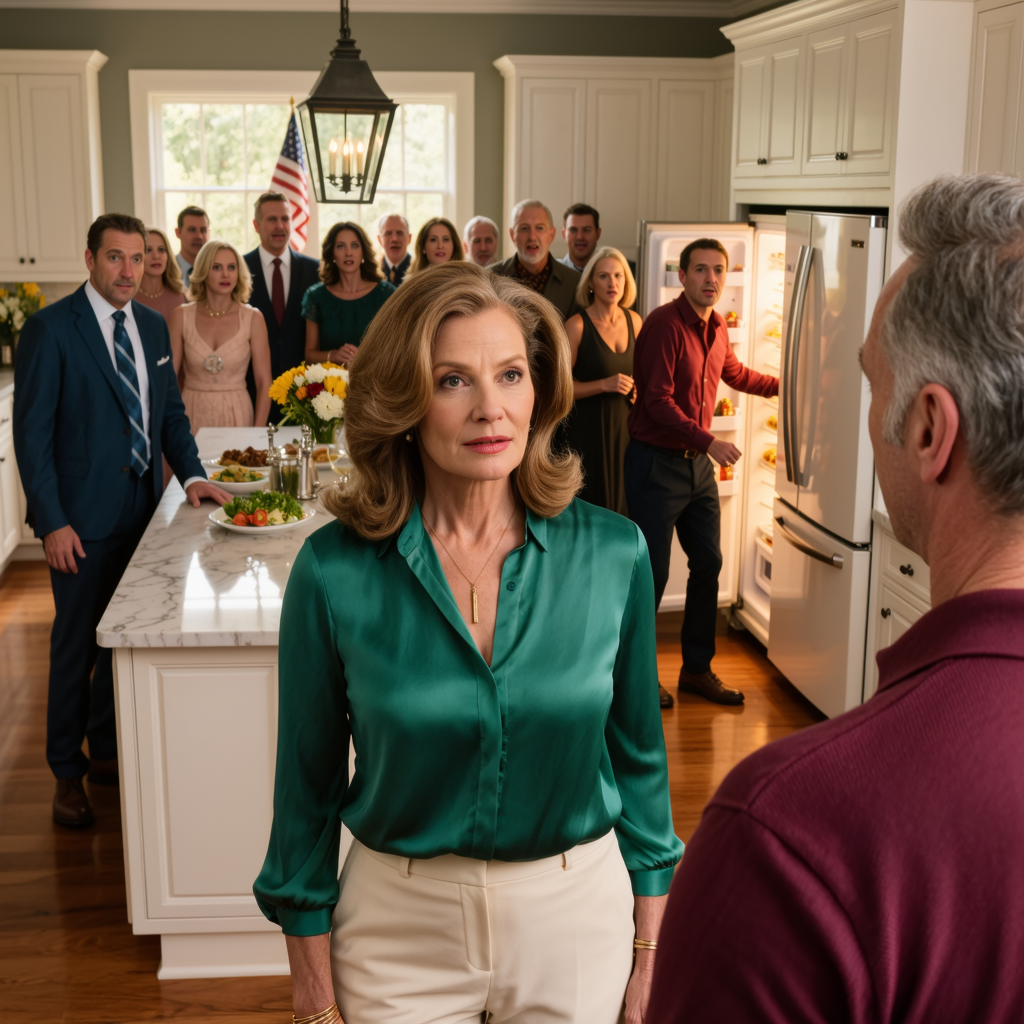
My husband looked at me across the kitchen table and said, “From now on, buy your own food. Stop living off me.”
I thought for one disorienting second that I had misheard him.
Morning light was slanting through the blinds in thin gold bars, laying stripes across the oak table we had bought twelve years earlier from a furniture warehouse off Route 59 in Naperville, back when we were still the kind of couple who stood in aisles debating table legs and laughing about how grown-up we felt. The table had collected the evidence of our life since then. A blue crayon line Emma had dragged across one corner when she was three. A pale ring from a sweating glass during a Fourth of July barbecue. A tiny burn where I had once set down a casserole dish too quickly during a Christmas rush. It was not a perfect table, but it was ours. Or at least I had believed it was.
I sat with both hands wrapped around my coffee mug, letting the heat press into my palms. Across from me, David stood at the counter in his pressed white shirt and navy slacks, slicing an apple with the calm precision he brought to everything. He had already knotted his tie, though he hadn’t put on his jacket yet. His phone lay faceup beside the fruit bowl, vibrating once every few minutes with emails from the city or Slack messages from his team. He was a vice president now at a tech firm downtown in Chicago, and the promotion had done something strange to his voice. It had sharpened it. Flattened it. Turned every sentence into something that sounded half like instruction and half like impatience.
“Excuse me?” I asked, because even then part of me thought there must be context missing, some bridge between what had existed in our marriage the night before and what he had just said now.
But he did not look at me. He kept slicing. One clean wedge after another.
“You heard me,” he said. “I’m tired of carrying everything around here.”
The apple knife clicked softly against the cutting board. The coffeemaker on the counter let out one last tired gurgle. Outside the kitchen window, a yellow school bus rolled past the entrance of our subdivision and the leaves on the maple near the driveway moved in a breeze that already smelled like October.
My fingers tightened around the mug.
Living off him.
That was the phrase that lodged first. Not buy your own food, though that was cruel enough. Not from now on, though there was something cold and official about it, like a policy announcement at work. No, it was living off him that stripped something raw.
Because if I had lived off anyone in this house, then what had the last twelve years been?
What had the nights awake with Emma’s fever been?
What had the doctor appointments and school forms and meal planning and budgeting and laundry and birthday parties and teacher emails and grocery lists and late-night pharmacy runs and every invisible thing that kept a family upright actually been?
I stared at him, waiting for him to soften. To laugh bitterly and say he didn’t mean it like that. To rub his forehead and tell me work was getting to him. To do anything that would let me believe this was stress and not truth.
But he just lined the apple slices into a neat row on a paper towel.
The humiliation of that may have been the worst part. That he could say something so brutal and then go right on arranging fruit.
“What brought this on?” I asked.
He exhaled through his nose like I was being deliberately difficult.
“What brought it on is that I’m the only one making money, Laura. I’m paying the mortgage. The insurance. The tuition deposits. The utilities. Everything. And lately it feels like no matter how much I do, it’s never enough.”
I almost laughed, not because anything was funny but because the unreality of the moment made laughter feel closer than tears.
“Emma goes to public school,” I said quietly.
“You know what I mean.”
“Do I?”
At that, he did look at me, but only briefly. His face had changed over the past year in ways other people might not have noticed. It was still the face that had smiled at me at twenty-nine in a rainstorm outside a Cubs game. Still the face Emma had inherited around the eyes. But there was a new hardness in the jaw now, a habit of looking at me as if I were one more thing waiting for his attention.
“I mean,” he said, “I’m tired of being treated like the backup plan for everyone else’s needs. So yes. From now on, buy your own food. For you. For Emma if you want. But stop acting like I’m supposed to fund everything just because I’m here.”
My breath left me slowly.
He had included Emma almost casually, as if our daughter were a line item he could shove across a table.
I thought of saying a hundred things. That I had left a promising design career because we both agreed one parent needed more flexibility once Emma was born. That my freelance work dried up because every time I tried to restart it, something at home or school needed me first. That the reason he had been able to stay late at the office and say yes to every ambitious opportunity was because I had been the one standing behind the curtain making sure the rest of life didn’t collapse.
Instead, I said only, “Okay.”
He wiped the knife on a dish towel. He took his briefcase from the chair by the door. He did not apologize. He did not ask whether I meant okay in anger or grief or surrender. He simply left.
The latch clicked shut, and the sound echoed through the kitchen so sharply it felt bigger than the room.
I sat there long after his car backed down the driveway and the subdivision quieted again.
The coffee in my mug went lukewarm. The apple slices stayed on the counter, turning slightly brown at the edges. I could hear the hum of the refrigerator and the distant bark of somebody’s golden retriever two houses over. The ordinary sounds of a suburban morning. The kind of sounds that make you think life is intact even while something essential is splitting open under the surface.
By the time Emma came downstairs, dressed in leggings and a purple hoodie and already arguing with herself about whether a quiz in science counted as “basically a test,” I had washed my face, rinsed my mug, and put David’s apple slices in a plastic container like I always did.
“Mom, are we out of the cinnamon waffles?” she asked, pulling open the freezer.
“No, sweetheart. Top shelf.”
She found them and popped two into the toaster. Ten years old, tall for her age, observant in a way that made me careful even when I was tired. Emma never missed much. She had David’s brown eyes but none of his instinct to turn feelings into silence. Her face opened to everything. You could still see each thought travel across it.
She looked at me after a minute.
“You okay?”
I reached up and tucked a strand of hair behind my ear. “Just didn’t sleep great.”
She nodded, accepting that answer for now, and began telling me about a poster project on the solar system.
I drove her to school an hour later under a bright Illinois sky with a low band of clouds over the western edge of town. The playground was alive with backpacks and crossing guards and minivans inching forward. I kissed the top of her head before she got out.
“Library after school?” I asked.
“Can we?” she said immediately. “I need the new astronomy book Mrs. Feldman mentioned.”
“Then yes.”
She smiled and hopped out.
I watched her join the stream of children moving toward the building, then sat in the pickup line long after the crossing guard waved the next car forward. It occurred to me then, not dramatically but with a strange, practical clarity, that if David meant what he said, I could either spend my days begging him to revise it or I could start taking him seriously.
By noon, I had opened a new checking account.
It was a small branch near downtown, the kind with bowls of mints on the desk and framed photos of smiling retirees on the wall. The banker was a young woman with a neat bun and kind eyes who asked if I wanted the account linked to any others.
“No,” I said.
She nodded as if she understood more than I had told her.
I deposited what little I had that was solely mine. A modest inheritance from my grandmother in Ohio that I had never fully touched. Birthday money from two years that I had tucked away instead of spending. Cash from selling some old design textbooks online. Small amounts left from grocery budgets I had stretched better than anyone knew. It was not much. But it existed. And in that moment, watching her slide the receipt across the desk, it felt like the first solid thing I had touched all day.
When I left the bank, I went to Jewel-Osco and bought groceries for exactly three days.
Bread. Eggs. Yogurt cups Emma liked. One rotisserie chicken. A bag of clementines. Pasta. Butter. Parmesan. A carton of milk. Peanut butter. Carrots. Rice.
No frozen appetizers. No extra meat. No party food. No things David liked that Emma and I did not.
At home I cleared a shelf in the pantry and installed a small lockable cabinet I ordered that afternoon and picked up from Target the next day. It was not dramatic-looking. It held groceries, not secrets. But when I hung the tiny key on a chain around my neck, I felt my pulse steady for the first time since breakfast.
That night David came home at 8:40, smelling faintly of cold air, printer toner, and the cologne he wore when he had to present to investors.
He glanced at the locked cabinet.
“What’s that?”
“My groceries,” I said.
His gaze moved to the key at my throat and then back to my face.
He said nothing.
Neither did I.
Emma was at the table doing math homework. She looked from one of us to the other, sensed the wrongness immediately, and lowered her eyes back to the page.
That became the rhythm of the next three weeks.
I bought food for Emma and me. I cooked enough for two. Some nights pasta with butter and parmesan. Some nights grilled cheese and tomato soup. Some nights roasted vegetables with rice and chicken. Easy meals. Quiet meals. Meals that left very little behind.
David adapted with the offended efficiency of a man who refused to admit he had been inconvenienced. He ordered takeout. He brought home salads from Sweetgreen and sandwiches from the train station. Some nights he ate at the office before he came home. Some nights he poured a bowl of cereal and stood at the counter like a tenant.
The kitchen changed first.
It had always been the warmest room in our house, even in winter. Not because of the heating vent under the window but because life happened there. Emma painted pumpkins at the table there every October. We rolled sugar-cookie dough there in December. Neighbors drifted in during summer barbecues and leaned against the counters with paper plates. It had been the room where birthdays began and worries got translated into practical lists.
Now it felt staged. Functional. Trimmed down to the needs of survival.
There are silences in marriage that are loud and theatrical, full of slammed cabinets and deliberate footsteps. Ours was worse. Ours was smooth. Polite. Even. We still discussed pickup schedules and dentist appointments and whether Emma needed a heavier jacket for soccer practice. We still texted about milk or batteries or the permission slip in Emma’s folder. But underneath all of it, his sentence sat between us like a line of barbed wire.
Buy your own food.
Stop living off me.
I turned it over at night while brushing my teeth. While folding Emma’s sweatshirts warm from the dryer. While standing at the kitchen sink watching the reflection of our backyard lights shimmer in the dark window. The words stopped being about groceries quickly. They became a translation key.
You are not my partner.
You are not my equal.
What you do does not count.
It was around the second week that I began noticing the phone.
Not because it had never buzzed before. David had always been tethered to work, and after his promotion, even more so. But there was a difference now in the way he handled it. He angled the screen away. He stepped out onto the back patio to answer certain calls. He smiled at messages and then let the expression vanish before he reentered the room.
I did not go through it. I did not ask to see it. Maybe some women would have, and maybe they would have been justified. But my pride had curdled into something sharper than jealousy. I did not want scraps. I wanted truth, and if truth had to come to me eventually, I wanted it standing upright, not fished from under digital rocks.
Claire noticed before anyone else.
We met for coffee every other Thursday if schedules allowed, usually at a café downtown near the Riverwalk where the windows fogged in cold weather and the cinnamon rolls were always gone by ten. Claire had known me since sophomore year at Michigan State, when I wore combat boots with sundresses and thought I would one day art-direct magazine covers in New York. She married a public-school history teacher, moved to Wheaton, and kept the exact same ability to look at my face for three seconds and know when I was lying.
“You’ve lost weight,” she said the first time she saw me after the kitchen conversation.
“I’ve lost appetite,” I corrected.
She leaned back in her chair. “What happened?”
I told her.
Not with tears. Not even with much emphasis. I repeated David’s sentence exactly and watched her expression harden by degrees.
“He said that to you?”
“In our kitchen. Before work. While slicing an apple.”
Claire shut her eyes for a second. “That detail makes me hate him more.”
I huffed out the beginning of a laugh despite myself.
“I know.”
“And what did you do?”
“I opened a bank account. Bought a cabinet. Started buying groceries for me and Emma.”
Now she did smile, but it was a proud, dangerous smile. “Okay. That’s clean. That’s elegant.”
“I’m not trying to be elegant.”
“No,” she said, lifting her cup. “But you are. Which is honestly more unsettling.”
I traced a finger around the lid of my latte. “I don’t know what happens next.”
“Maybe nothing,” Claire said. “Maybe he expects you to fold. Men like that often do.”
“He’s not—”
“Don’t defend him out of habit,” she interrupted gently. “Not to me.”
I looked out the window at the Riverwalk, at a man in a Notre Dame sweatshirt pushing a stroller past the water.
“He used to be softer,” I said.
“Maybe,” she replied. “Or maybe you used to have more cushion between his edges and your skin.”
That line stayed with me.
I thought about it when Emma asked one night why Dad had eaten tacos from a paper bag in the den instead of at the table with us.
“Busy day,” I said.
She twirled spaghetti around her fork and looked at me from under her lashes. “Are you guys mad at each other?”
Children ask questions like they’re placing a glass ornament on a table. Gently. Carefully. Knowing it matters.
“We’re figuring some things out,” I said.
She nodded, but I knew she knew more than that.
Emma had always lived half a beat ahead of her age. She noticed when tension entered a room. She could track tone the way some children track weather. So I began being more intentional with her in those weeks. We kept our library afternoons. We baked muffins one Sunday morning just because she wanted to add too many blueberries. We drove to Morton Arboretum on a cool Saturday and walked under turning leaves until our sneakers were damp with mud and she asked me if black holes could swallow time itself.
I watched her on those afternoons with a kind of sharpened tenderness.
Because the truth I had avoided for years was no longer avoidable: she was learning how women should be treated by watching me accept how I was treated.
That realization settled into me so fully that by the time David’s birthday approached, my anger had changed form. It was no longer hot enough to rant over. It had cooled into decision.
Every year David’s birthday was the same.
His mother, Patricia, would call a week ahead in that polished voice of hers and ask whether I was making “the good lasagna” as though there were a lesser one somewhere. Tom and Mike would bring little or nothing but appetite. Their wives, Sarah and Lisa, were not bad women, just practiced in the family habit of arriving empty-handed and acting overwhelmed by the very idea of hosting. Their children tore through the house like a weather system. Patricia criticized the details in soft focus. David basked in being the center of a warm, loud family gathering he did not actually create.
And I—every year—I carried it.
The shopping, the cleaning, the cooking, the timing, the hidden labor, the midnight cleanup after everyone drifted out telling David what a wonderful evening it had been.
This year the guest list landed at twenty.
I knew because Patricia texted me names with the assumption that I would translate them into grocery quantities.
Tom, Sarah, Ethan, Noah.
Mike, Lisa, Sophie, Mia, Ben.
Aunt Karen. Cousin Jenny. Uncle Rob and his new wife. Patricia’s sister Marlene. Two college-age nephews home for the weekend. And so on.
I stared at the list at the kitchen counter and felt almost calm.
Twenty people.
Twenty people expecting the machinery of my labor to hum into place because that was what it had always done.
Two weeks before the party, I stopped buying party staples entirely.
No flour. No extra sugar. No heavy cream. No roast meat. No frozen appetizers in the garage freezer. No gallon tubs of vanilla ice cream. No lasagna noodles. No cake ingredients.
Only enough for Emma and me.
Patricia called the day before.
“Laura, dear,” she said, “we’re all so excited for tomorrow. You are making that chocolate cake, aren’t you? David just loves that ganache.”
The sky outside was gray, and I was standing at the sink rinsing grapes while Emma worked on a poster board at the table.
“Oh, Patricia,” I said in my sweetest voice, “don’t worry. It’ll be memorable.”
There was a pause. “I’m sure it will.”
After I hung up, I opened the refrigerator and looked at the shelves.
A carton of milk. Six eggs. A bag of carrots. Butter. Yogurt. Two apples. Leftover chicken soup in a glass container. One bottle of mustard.
That was it.
The pantry looked equally bare except for my locked cabinet.
For a moment I felt the edge of guilt.
Not toward David.
Toward the children.
Then I remembered that children did not create the expectation that one woman should quietly feed an entire extended family while being told she was a financial parasite in her own home. If there were pizza the next day, they would eat pizza. They would survive. In fact, most of them would probably be thrilled.
That night David came home later than usual, loosened his tie, and asked from the doorway of the kitchen, “Everything good for tomorrow?”
I dried my hands on a dish towel and met his eyes.
“Everything’s taken care of.”
He nodded, distracted, and headed upstairs to shower.
He never asked what that meant.
He never looked closely enough to see that the refrigerator shelves echoed when opened.
The morning of his birthday dawned bright and cold. The kind of Midwestern October day that looks cheerful through a window and bites your face the second you step outside. Emma was at a sleepover with her friend Lily, exactly where I wanted her. I had arranged it carefully and without explanation.
I woke early and moved through the house with unusual peace. I made coffee for myself using the last of the beans. I vacuumed the living room. I dusted the bookshelf in the den. I folded the throw blankets on the sofa. I set extra chairs in the dining room and polished silverware that would not be used.
What I did not do was cook.
No sauce simmered on the stove.
No bread dough rose under a towel.
No butter softened on the counter.
By noon the house looked impeccable everywhere except the room where effort was actually expected.
At one-thirty, David wandered into the kitchen in flannel pajama pants, hair still tousled, and frowned at the empty coffee pot.
“Where’s the coffee?”
“Gone,” I said, taking a sip from my mug.
He rubbed the back of his neck. “Can you make more?”
“With what?”
He looked at me for half a second, not understanding, then shrugged and headed upstairs to get dressed.
At three o’clock the first doorbell rang.
Patricia entered as if she were arriving at a catered luncheon. Camel wool coat. Leather gloves. Big gold earrings. A gift bag with tissue paper so bright it looked festive by force. She kissed David on the cheek, let him take the bag, and then scanned the living room.
“No balloons?” she said.
“Not this year,” I replied.
Tom and Sarah arrived next with their boys. Mike and Lisa came after with the little ones. Then the rest, carrying bottles of wine or bakery cookies or nothing at all. Within fifteen minutes our house was full of overlapping voices, children thudding down the hallway, coat sleeves catching on banisters, Patricia making sotto voce observations about the absence of centerpiece flowers.
David was in his element. Smiling. Clapping men on the shoulder. Asking people if they wanted sparkling water or beer. Accepting birthday greetings with an ease that had always infuriated me because it rested on so much unseen labor.
Then Patricia asked the question.
“Laura, darling, where’s the food?”
She said it lightly, but her gaze had already slid toward the dining room, where the table sat bare except for a stack of paper plates I had placed there that morning almost as a joke to myself.
“In the kitchen,” I said.
I even gestured for emphasis. “Help yourselves.”
And they did.
All of them drifted toward the kitchen as if drawn by scent, by habit, by memory. David came last, still glancing down at his phone, probably at some message from work. The chatter was thick until the exact moment the first few crossed the threshold.
Then it stopped.
Not gradually. Instantly.
The kind of stop that makes air feel different.
I stood in the doorway and watched twenty pairs of eyes register what was in front of them.
The open refrigerator with its lonely contents.
The barren pantry shelves.
The cold stove.
The clear counters.
The locked cabinet hanging behind me in the pantry corner, its key resting against my collarbone.
Patricia blinked.
Tom let out a little sound like a cough trapped in confusion.
One of the teenagers muttered, “Uh…”
David looked from the fridge to me and back again.
“What is this?” he asked.
His voice was low at first, which made it worse.
I folded my arms loosely. “You told me to buy my own food.”
He stared.
“For Emma and me,” I added. “So I did.”
The refrigerator hummed into the silence.
From the backyard came the muffled shriek of little kids chasing each other before they understood anything was wrong.
David’s face changed in stages. Confusion. Realization. Anger.
“This is not funny.”
“Neither was what you said.”
His mother looked from him to me, then back again, trying to locate the shape of the social script and failing.
“Laura,” she said slowly, “where is the lasagna?”
I turned my head just enough to meet her eyes. “There isn’t one.”
The room seemed to pull inward.
“What do you mean there isn’t one?” Patricia asked.
“I mean there isn’t one.”
Tom shifted his weight. Sarah looked at the floor. Mike stepped half a pace back as if he wanted no part of the blast radius. Lisa drew Sophie closer when the child wandered inside asking for juice.
David took two steps toward me.
“You’re embarrassing me in front of my family.”
There it was. Not You’re hurting me. Not Let’s talk in private. Not I was wrong.
Embarrassing me.
I felt my spine straighten all by itself.
“Embarrassing you?” I repeated. “You told me to stop living off you, David. You told me to buy my own food. So I stopped stocking this kitchen for everybody else. I stopped buying groceries for your parties. I stopped pretending that feeding your entire family was my job while you stood here collecting credit for it.”
His nostrils flared. “That’s not what I meant.”
“Then what did you mean?”
He opened his mouth and closed it.
No answer came.
Because that was the problem with cruelty when spoken plainly: once repeated back in public, it no longer sounded like stress. It sounded like exactly what it was.
Patricia recovered first.
“This is unacceptable,” she snapped. “You don’t invite family into your home and leave them unfed.”
“I didn’t invite anyone,” I said. “David did.”
All eyes turned to him.
For one brief, extraordinary second, he looked unarmored. Smaller. Not because the room had turned against him in full, but because it had stopped protecting him automatically.
Mike, true to form, tried to rescue the moment.
“Okay,” he said, holding up both hands. “Not ideal. But no big deal. We’ll just order pizzas.”
“No,” I said.
The word landed so firmly that even I felt it.
He stared. “No?”
“I’m done fixing it.”
I looked around the kitchen. At the women who had watched me host for years as if it were a hobby. At the men who had eaten and left. At the mother-in-law who had mistaken criticism for personality. At David, who had mistaken my labor for natural background noise.
“For years,” I said, “I cooked and planned and cleaned and budgeted for these gatherings. I spent days preparing while everyone else arrived, ate, and left without once asking what it cost. Not just in money. In time. In effort. In exhaustion. David made it clear that I’m on my own now, so if the rest of you want a party, you can handle it yourselves.”
Nobody spoke.
Then, unexpectedly, Jenny cleared her throat.
Jenny was David’s cousin, thirty-eight, a quiet elementary-school speech therapist who usually sat near the edge of gatherings and stacked plates without drawing attention to herself. She stepped forward now and looked at me with the kind of directness that comes from someone who has been noticing for years in silence.
“She’s right,” Jenny said.
The room shifted.
“She always does everything,” Jenny continued. “We come here and act like the food just appears. I’ve done it too. We all have. I’m sorry, Laura.”
The apology was so simple it almost undid me.
Lisa nodded slowly. “Honestly, same. I didn’t think about it because you always made it look easy.”
Tom scratched the back of his neck. “Yeah. I guess we’ve been kind of useless.”
Patricia made a small sound of disgust, but the authority had drained from it.
“This is still no way to treat family,” she said.
I held her gaze. “Family should know better than to treat one person like the hired help.”
Her lips parted. Closed.
David stepped close enough that only I could hear his next words.
“This was petty.”
I answered just as softly.
“No. Petty would have been serving everybody except you.”
He stared at me.
“What this is,” I said, “is me finally taking you literally.”
Something in his face faltered.
Mike, deciding practicality mattered more than pride, pulled out his phone again. “Okay. I’m ordering pizzas. Deep dish or thin crust?”
This time I said nothing.
He took my silence as permission.
The spell broke in uneven stages after that. Children got rounded up from the yard. Sarah found paper napkins in a drawer. Tom made a run to the gas station for soda and chips. Patricia produced a backup bag of pretzels from her tote with the put-upon expression of a woman forced to survive wartime conditions. The teenagers looked vaguely delighted by the scandal.
I did not lift a finger.
That was the hardest part at first. Not speaking, not stepping in, not automatically smoothing the edges when nobody could find the extra serving plates or when Ben spilled juice or when Patricia muttered too loudly that the pizza place had gotten her order wrong. Years of training rose in my muscles like instinct.
But I stayed where I was.
And something remarkable happened.
The sky did not fall.
Nobody starved.
The men carried boxes. The women cleaned spills. The children were handed tasks and, after some whining, completed them. The evening continued—less polished, far less graceful, but undeniably possible.
At one point I caught Jenny watching me with the smallest smile.
“What?” I asked.
“I’m just realizing,” she said, “that every family has an axis and nobody notices it until it shifts.”
I looked at the pizza boxes stacked on my dining table.
“Maybe.”
“No,” she said. “Definitely.”
The strangest part was that once the initial shock wore off, some people seemed lighter. Tom laughed louder once he had finished running errands. Lisa sat down with a slice and actually ate instead of performing hostess-adjacent apologies all evening. Even the kids were happier with pizza and brownies than they would have been with lasagna and salad they had to be told to finish.
Only David remained rigid.
He circulated, smiled when required, and answered birthday greetings, but there was a new caution in him. A sense that he had walked into a room expecting his life to behave one way and found the mechanics exposed instead.
Emma came home just after six with Lily’s mother dropping her at the curb.
She walked inside, stopped short at the sight of pizza boxes and paper plates, and looked at me.
“What happened to the big dinner?”
I crouched to her level. “I took a break this year.”
She glanced at her father, who was helping Mike clear bottles from the counter, then back to me.
“Are you okay?”
There was no accusation in it. Only concern.
And maybe that was the moment I knew I had done the right thing.
Because when she asked, I could answer honestly.
“Yes,” I said. “I really am.”
The family left earlier than usual.
There were awkward hugs, a few mumbled thank-yous, some overcompensating cheerfulness from the cousins, and Patricia standing in the foyer pulling on leather gloves as if she had been the one put through an ordeal.
“Happy birthday, David,” she said with stiff dignity.
Then she looked at me.
“We’ll talk later.”
I smiled politely. “Maybe.”
When the door shut behind the last guest, the house went quiet in a way that felt almost holy.
The dining room smelled like oregano and cardboard. Empty soda cans lined the counter. One paper plate had melted slightly against a still-warm pizza box. Emma was upstairs brushing her teeth. Somewhere in the pipes, water shifted and knocked.
David stood in the kitchen with both hands braced on the counter.
“We need to talk,” he said.
“We do,” I agreed.
He turned. “What the hell was that?”
I was too tired for theatrics.
“That,” I said, “was a direct consequence.”
“You made me look ridiculous.”
“No, David. You did that when you told your wife to stop living off you and then expected her to throw you a party.”
His jaw tightened. “I was angry.”
“So was I.”
“You knew I didn’t mean it literally.”
“That’s the luxury of being careless with other people,” I said. “You get to say cruel things and then blame them for not translating.”
He stared at me as if I had started speaking another language.
For twelve years I had been the interpreter of his moods, his silences, his stress. Suddenly I was refusing the job, and he did not know what to do with the vacancy.
“I’m not doing this tonight,” I said after a moment.
He gave a short laugh. “That’s convenient.”
“No. What’s convenient is waiting until after your family leaves to notice what you said had consequences.”
I picked up two empty cups and carried them to the trash.
“Laura—”
“Not tonight.”
He did not follow me when I went upstairs.
The next morning he made coffee.
Enough for two.
It was such a small thing that if you blinked, you could miss its meaning. He set my mug on the table without a word and poured his own. Emma was still asleep. The house was soft with Sunday quiet.
I looked at the mug. Then at him.
“Thank you,” I said.
He sat down across from me.
For a long time neither of us spoke.
Then he said, “I shouldn’t have said it like that.”
It was not an apology. Not really. But it was the first crack.
“Like what?” I asked.
He rubbed his thumb against the handle of his cup.
“Everything.”
I let the silence press.
He kept talking.
“I’ve been under a lot of pressure at work.”
I nearly smiled at the predictability of it.
“Pressure doesn’t invent contempt, David. It reveals it.”
His eyes flicked up to mine.
“I don’t feel contempt for you.”
I thought of the apple slices. The tidy voice. The ease.
“Then whatever you feel is doing an excellent imitation.”
He looked away.
That was the beginning of a long, uneven period that I can only describe as the unraveling of the script we had both been following.
David did not become tender overnight. He did not suddenly transform into a man who recognized emotional labor because one embarrassing family dinner exposed its absence. Real life is less cinematic than that. People are stubborn. Shame is clumsy. Habit is powerful.
But things shifted.
He bought groceries for the house again.
He started asking before assuming.
He joined Emma and me at the table more often.
And I, having crossed a line inside myself, could not go back to who I had been before.
I found a small freelance design job through a friend of Claire’s who ran a boutique marketing firm in Oak Brook. It was only ten hours a week at first—social graphics, some brand refresh work for a local pediatric dental practice—but when I opened Adobe Illustrator again after so many years, it was like hearing my own name called from a distance and realizing I still recognized it.
At night, after Emma went to bed, I took an online course in newer design software and UI basics. I worked at the desk in the guest room with a fleece blanket around my legs and the hum of the dryer downstairs. The house around me felt different in those hours. Less like a place where I performed and more like a place where I existed.
Emma saw the difference faster than David did.
One evening over spaghetti, she watched me answer an email from a client on my phone and said, “I like when you talk about work. Your whole face changes.”
I laughed. “In a good way?”
“In a bright way.”
Children say things adults spend entire therapy sessions trying to articulate.
So I kept going.
I stopped doing David’s laundry unless he specifically asked and I specifically agreed. I stopped answering his work emails when he tossed his phone toward me from the couch and said, “Can you just reply that I’ll look at it tomorrow?” I stopped overexplaining my no.
At first he resisted in small, incredulous ways.
“Can you not just—”
“No.”
“Why is this such a thing now?”
“Because it always was. I just finally noticed.”
Claire called it boundary rehab.
“You’re retraining the ecosystem,” she said over coffee. “Everyone’s mad because gravity changed.”
She was right.
Patricia was the first external symptom.
Three months after the birthday dinner, on a Thursday afternoon cold enough to silver the edges of the lawn, she appeared at my front door holding a thick stack of envelopes secured with a rubber band.
I knew from her face it wasn’t a social call.
Patricia never looked disordered in public. Not at church, not at family events, not even at funerals. She believed in lipstick as moral structure. But that day her coat was half-buttoned, her hair slightly windblown, and there was a rawness around her mouth I had never seen.
“Can I come in?” she asked.
I hesitated just long enough for her to register that she no longer had automatic access.
Then I stepped aside.
She entered the kitchen slowly, as if the room might still remember humiliating her. I did not offer coffee. I did not ask about traffic. She placed the envelopes on the table one by one and sat down.
“What is this?” I asked.
“Bills.”
I looked at the stack. A utility notice. Two credit card statements. Something from a medical billing company. A pink final notice from a condo association in St. Charles. Not ours.
“Why are you bringing these to me?”
Her shoulders lifted in a brittle little shrug. “Because David hasn’t told you.”
A current of cold moved through me.
“Told me what?”
Patricia folded her gloved hands too tightly. “Your brother-in-law Mike has been struggling.”
I waited.
“He got behind after the roofing business slowed down. Then Lisa’s part-time hours were cut. Then Sophie broke her arm last spring and the deductible—” She stopped, irritated at her own vulnerability. “Anyway. David has been helping.”
Helping.
The word immediately expanded in my mind to include amounts, frequency, secrecy.
“How much?” I asked.
She looked away. “I don’t know the full amount.”
That meant it was enough to embarrass her.
“Try.”
She inhaled sharply. “He covered some mortgage payments. Some medical bills. School clothes once or twice. There were… other things.”
I felt suddenly very still.
“And you thought you should bring this to me because?”
Her chin rose a fraction, old instinct returning. “Because family shouldn’t let family sink.”
I almost admired the audacity.
“Let me make sure I understand,” I said. “David told me to stop living off him while he was quietly paying other people’s bills?”
Patricia’s eyes darted to mine and away. That reaction told me everything.
“How long?”
“A while.”
“How long, Patricia?”
“Maybe eighteen months.”
Eighteen months.
A year and a half.
I sat down slowly before my knees made the decision for me.
Now the phone made sense. The tension. The new hostility around money. The contempt shaped like martyrdom. He had been carrying everyone, and rather than admit he felt trapped, he had looked for the nearest person least likely to fight back and laid the resentment there.
On me.
“Why are you showing me this now?” I asked.
Her voice changed then. Less polished. More desperate.
“Because Mike can’t catch up. The condo association is threatening action on my sister’s place where he’s staying temporarily. Lisa is in a panic. David says he can’t keep doing it. And after… after what happened at the birthday, he says things have to be discussed differently now.”
I stared at her.
Not because the sentence was shocking, but because it was so revealing.
After what happened at the birthday.
As if the birthday had been the problem. As if the humiliation was not a symptom of years of imbalance but an isolated social malfunction.
Patricia leaned forward.
“I know we have not always seen eye to eye.”
That was one way to phrase twelve years of condescension.
“But I am asking you woman to woman to help stabilize this family. David listens to you more than he listens to anyone.”
For one absurd second, I nearly laughed.
The old role was being offered back to me dressed up as importance.
Stabilize this family.
Meaning: resume absorbing what no one else wants to hold.
I looked at the envelopes again.
“How much does David owe?”
She hesitated.
That told me there was more.
“How much?” I repeated.
She said a number.
I will not write it here because even now it makes my stomach tighten, but it was enough to explain a year of clipped tension, enough to change the way I understood every argument we had had about groceries, repairs, extracurriculars, and the cost of replacing our aging dishwasher.
It was also enough to make one thing painfully clear.
David had not been angry because I contributed nothing.
He had been angry because I was the only person in his orbit he expected to absorb his panic without resistance.
Patricia watched my face carefully.
“I know this is upsetting.”
“No,” I said. “Upsetting was breakfast three months ago. This is clarifying.”
She stiffened.
“I came because I thought you would want the truth.”
“And what exactly do you think I’m supposed to do with it?”
“I thought perhaps you could help him understand that family has obligations.”
I looked at her for a long moment.
“David is a forty-four-year-old man,” I said. “If he wants to help his brother, he can choose that. But he does not get to finance an entire rescue operation in secret, lash out at me, and then expect me to step in and manage the fallout once the lies get expensive.”
Her mouth thinned. “Mike could lose everything.”
I felt something cold and settled inside me.
“You should get used to hearing no from women in this family,” I said.
Patricia recoiled as if I had slapped her.
For years, that reaction alone would have been enough to make me soften. To rephrase. To smooth the sentence until it no longer had edges.
I did not.
Instead I stood, gathered the envelopes into a neat pile, and slid them back toward her.
“You need to take these to David,” I said. “Not me.”
“I already did.”
“And?”
“He said there would be a meeting.”
I blinked. “A meeting?”
“With the family. Sunday. Here.”
Of course.
Of course the next phase of this drama would assume my kitchen as venue before it had my consent.
I stared at her until she looked uncomfortable.
“No,” I said.
She frowned. “No?”
“No family summit in my house unless I agree to it.”
“He already told everyone—”
“Then he can untell them.”
Patricia stood. “Laura, really. This is bigger than your feelings.”
That sentence may have been the moment whatever remained of my fear of her finally died.
My feelings.
As though the issue were not betrayal, secrecy, contempt, financial dishonesty, and a system that expected one woman to lubricate all of it.
“I’ll tell you what’s bigger than my feelings,” I said. “My daughter. My future. My ability to trust the person I’m married to. Those are bigger.”
Her face hardened. “You are making this harder than it needs to be.”
“No. I’m making it visible.”
When she left, I locked the front door, leaned against it, and stood there listening to my own breathing.
Then I called Claire.
She answered on the second ring.
“What happened?”
I told her everything.
There was a silence.
Then: “Oh, Laura.”
“I know.”
“No,” she said, voice sharpening. “I need you to hear this correctly. He did not just insult you. He displaced a crisis onto you because you were safer to punish than the people actually creating the pressure.”
I sank onto the bottom stair in the foyer.
“Yes.”
“And now they want you to mother the whole mess.”
“Yes.”
“Absolutely not.”
I let out a breath that was almost a laugh. “That’s more or less where I landed too.”
“Good.”
That evening David came home and knew immediately something had happened.
It may have been the way I was standing at the counter when he walked in. It may have been the untouched mail. It may have simply been that after twelve years, for all his blind spots, he could still feel weather when it gathered.
“What did she tell you?” he asked.
Not hello.
Not has Emma started her homework.
What did she tell you.
“Everything she thought she could get away with.”
He closed his eyes briefly.
“Laura—”
“No. You don’t get to start with my name like that. Sit down.”
He looked surprised.
Then he sat.
I remained standing.
“Did you send money to Mike?”
“Yes.”
“For how long?”
He rubbed his jaw. “About a year.”
“Eighteen months?”
A beat.
“Yes.”
“Did you tell me?”
“No.”
“Did you tell me to stop living off you while secretly paying other people’s bills?”
He looked up at me then, and to his credit, he did not insult me further by pretending not to understand the scale of what he had done.
“Yes.”
I nodded once.
Emma was upstairs. I could hear the faint thump of music from her room, some pop song bleeding through cheap earbuds. The dishwasher was running. A soccer ball rolled somewhere across the hardwood where she must have left it by the entryway. Life was happening around us, ordinary and intact-looking, while the center kept changing shape.
“Why?” I asked.
His shoulders slumped in a way I had never seen.
“Because I felt trapped,” he said. “Because Mike kept saying it was temporary. Because Mom kept crying. Because I thought I could fix it if I just carried it long enough. And because every time I came home and saw another bill or another grocery receipt or another thing that needed money, I felt like I was drowning.”
I listened.
Then I said, “So you picked the person least likely to leave and treated her like the problem.”
He flinched.
“Yes,” he said quietly.
There are moments in marriage where truth arrives so plainly that it clears the fog even while it hurts. This was one of them.
He was not confused.
He was not misunderstood.
He was afraid, and he had chosen cowardice over honesty.
“I want the full picture,” I said. “Every transfer. Every bill. Every debt. Everything you promised other people with money that affects this house. If there is one more surprise, one more hidden obligation, one more person showing up at my door with paper in hand, I am done. Do you understand me?”
He looked at me for a long moment.
Then he said, “Yes.”
Sunday did happen.
But not as a rescue meeting in my kitchen.
It happened in a conference room at the public library because I refused to host it like a family drama brunch. David booked the room himself. Mike and Lisa came. Patricia came. Tom came because apparently every family crisis in America eventually includes one man who doesn’t fully understand the facts but thinks he should still weigh in. Claire met me in the parking lot first and squeezed my hand before I went inside, like a lawyer in a sweater set.
The meeting was ugly in the useful way.
Facts replaced vagueness. Numbers replaced guilt. It became clear within twenty minutes that Mike’s finances had not simply “gotten behind.” There had been poor decisions, pride, denial, and more optimism than math. David had covered enough that everyone else could keep pretending the problem was temporary. Patricia had encouraged the secrecy because she believed disclosure would “create tension.”
I looked at her across that fluorescent-lit room and thought, Tension is what families call truth when they prefer convenience.
When Mike finally said, “I didn’t ask him to tell Laura,” I felt something in me go still.
“Let me help you with that,” I said. “You did ask him not to tell me. Which is another way of saying you were comfortable letting my marriage absorb the impact as long as your household stayed afloat.”
Lisa burst into tears at that, which I would have pitied more if I were not so tired.
David did something then I had not expected.
He said, clearly and in front of all of them, “This is on me. I should have told Laura. I shouldn’t have hidden it. And I definitely should never have spoken to her the way I did.”
The room went quiet.
Patricia looked offended by the very concept of public accountability. Tom stared at the tabletop. Mike looked ashamed.
It did not heal anything immediately.
But it mattered.
By the end of the meeting, the outline of a real plan had emerged. Mike would sell equipment he had been keeping out of pride. Lisa would pick up more hours temporarily and meet with a financial counselor through her credit union. Patricia’s sister would stop letting family denial masquerade as generosity. And David would not send another dollar without discussing it with me first.
When we walked out into the library parking lot, the wind had picked up. Emma was at Claire’s house eating grilled cheese and watching a movie with Claire’s youngest, mercifully untouched by the afternoon.
David stood beside me near the row of sycamores shedding bark in papery strips.
“I know that wasn’t enough,” he said.
“No,” I replied. “It wasn’t.”
He nodded. “I know.”
I looked at him. Really looked.
This was the man I had loved. The man who had once driven to Indiana at midnight because I said I missed lake air. The man who built Emma’s first IKEA bed backwards and laughed until he cried when it collapsed. The man who had become capable, under pressure, of treating me like collateral damage.
Both things were true.
“I don’t know what happens now,” he said.
“I do,” I said.
He waited.
“We go to counseling. Real counseling. Not one session, not a gesture. You show me every account. Every card. Every transfer. I continue working. My money stays in my account unless and until I decide otherwise. We do not host another family event until I say we do. And if you ever speak to me like that again, there will not be a second public lesson. There will be paperwork.”
He exhaled slowly.
“Okay.”
I almost smiled at the echo.
Okay.
The same word I had given him in the kitchen months before, only now it meant something very different.
We went to counseling.
Not the soft kind where people talk around the edges until time runs out, but the kind where a woman in her sixties with silver hair and sharp glasses asked David, three sessions in, “Why was your wife the emotional landfill for pressures she did not create?” and then waited until he answered.
Some sessions left me trembling with anger. Some left him pale with shame. Some were useless. Some were clarifying. What changed was not magic. It was repetition. Truth told more than once. Patterns named. Responsibilities reassigned.
At home, life stayed ordinary in the way real repair often does.
Emma had soccer on Tuesdays and piano on Thursdays. I took on more design clients. One of them recommended me to another, and by spring I was working nearly twenty hours a week. I bought myself a refurbished iMac with money from my own account and set it on the desk in the guest room without asking anyone’s permission. David learned how to grocery-shop without expecting applause. He started making breakfast on Saturdays, clumsy pancakes at first, then better ones. He attended one of Emma’s science nights without checking work email under the table.
Trust did not return in a rush.
It returned in fragments, each one suspiciously earned.
There were setbacks. A hidden Venmo transfer once, small but maddening, because he “didn’t want to make a big thing out of helping Mom with her car repair.” A tense fight in March when Patricia implied at Sunday lunch that I was “keeping score too carefully these days.” The old patterns still lived in the walls. But now I could see them. Name them. Refuse them.
That changed everything.
A year later, when David’s birthday came around again, we did not host twenty relatives.
We did not perform abundance we could not feel.
Instead, we invited Emma’s favorite aunt, Claire and her husband, Jenny, and two close friends from David’s office who had actually become friends rather than career furniture. I made lasagna because I wanted to, and because after everything, I still made excellent lasagna. David chopped vegetables beside me. Emma set the table and complained theatrically about having to fold cloth napkins in a way that “looked fancy but not weird.”
The kitchen was warm that evening, softly noisy, alive in a way that belonged to all of us and not just to me. At one point I looked around and realized I no longer felt like the sole engine of the room. People moved because they understood movement was shared.
That was all I had ever wanted.
Not luxury.
Not praise.
Partnership.
Patricia arrived late with a bakery cake and a careful expression, as if unsure how much of herself she was still allowed to bring inside. She thanked me, actually thanked me, when I handed her a plate. The words sounded unfamiliar in her mouth.
Tom brought a tray of brownies. Mike brought nothing but did show up sober-faced and carrying a folded check toward an old debt, which he pressed into David’s hand with visible discomfort. Lisa hugged me in the hallway and whispered, “I know I never said it properly, but thank you for making us look at things.”
I accepted that with more grace than I once would have, perhaps because grace feels different when it is no longer compulsory.
Later that night, after everyone left and Emma had gone upstairs with frosting on her cheek, David and I stood in the kitchen loading the dishwasher.
He handed me a plate.
“I used to think providing meant money,” he said.
I slid the plate into the rack. “A lot of men do.”
He nodded. “I know better now.”
I looked at him. “Knowing better and doing better are cousins, not twins.”
He gave a small, tired smile. “Fair.”
It was not a fairy-tale ending. We were not reborn under string lights and dishwasher steam. I did not forget what he had said, and he did not deserve for me to. Some injuries remain as topography even after the wound closes. They change the map.
But our house no longer ran on my silent depletion.
The kitchen no longer felt like a stage where I performed usefulness in exchange for belonging.
It was simply my kitchen again.
Ours, when earned.
Mine, when necessary.
And if there is one thing I know now, it is this:
Silence is not always surrender.
Sometimes it is measurement.
Sometimes it is a woman looking at the line someone has drawn and deciding, very calmly, to let him discover what life looks like on the other side of it.