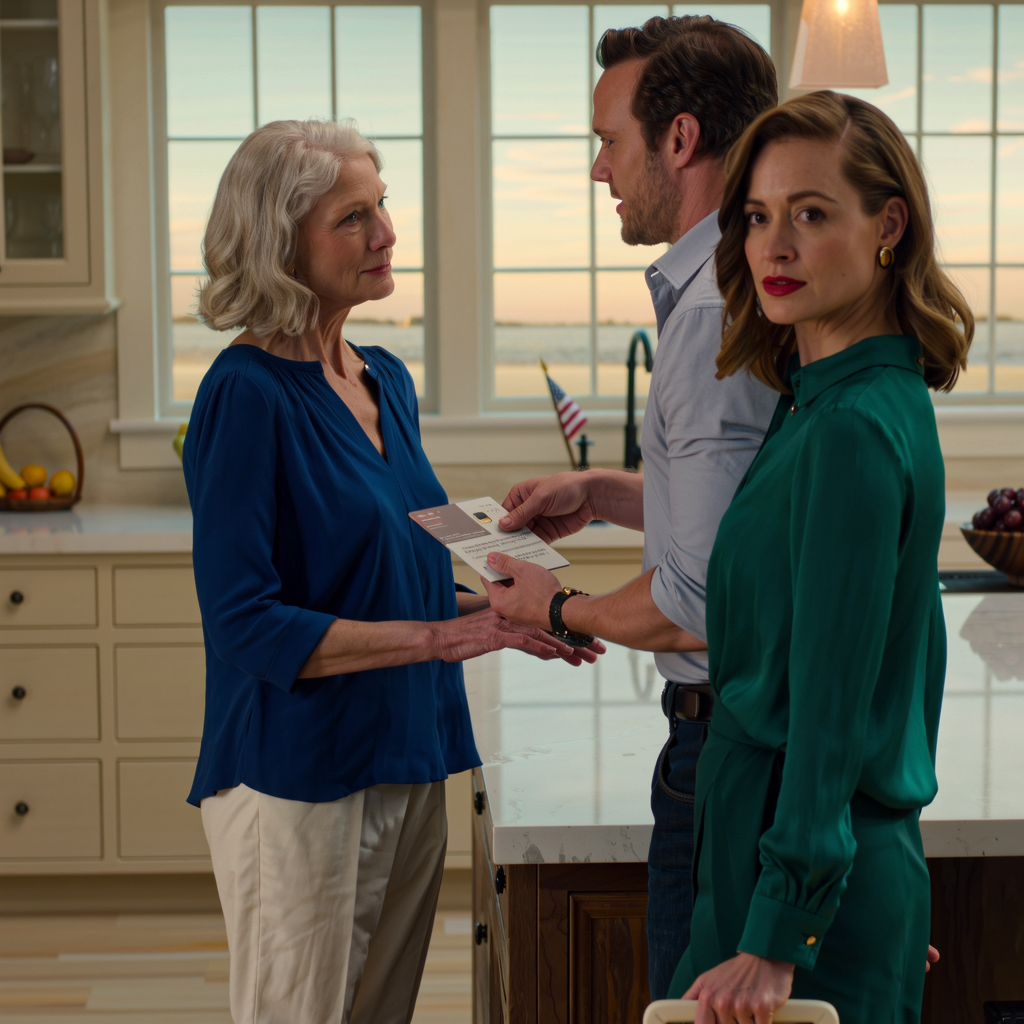
The next morning, the doorbell rang three times in quick succession, sharp and impatient, as if urgency itself had taken on human hands. I knew who it was before I opened the door. My son Richard only ever came by without calling when he wanted something.
I set down my half-finished cup of tea on the kitchen counter and walked slowly through the hall. Through the front window, I saw his black SUV parked crookedly outside the gate, expensive and careless, like an object that had never been denied anything in its life. Richard had inherited his father’s instincts for business, but none of Edward’s patience and none of his ability to hide contempt behind charm.
When I opened the door, he was already halfway inside.
“Mom,” he said.
No hug. Just the faint brush of an obligatory air kiss near my cheek before he moved past me as though he still lived there, as though he still had the right.
“We need to talk.”
He headed straight to the kitchen. He sat in my chair at the table, placed a brown folder in front of him, and kept typing on his phone with both thumbs. He did not ask whether I was busy. He did not ask whether I was all right. He did not even look up.
“A cup of coffee would be nice,” he said.
I made it automatically.
Ten years into widowhood, and I was still serving the men in my life as if that were the shape of my existence. Pour. Stir. Set the cup down. Step back. Wait.
When I placed it in front of him, I noticed how tense his hands were, how white his knuckles had gone around the phone.
“How are Fernanda and the kids?” I asked.
He took one sip.
“They’re fine.”
That was all. Flat, dismissive, a door shut with one word. He set the phone aside at last, leaned back in my chair, and slid the folder across the table toward me.
“I’ll get straight to it,” he said. “Mom, I’m in trouble.”
I sat down opposite him. The clock on the wall ticked louder than it needed to. Outside, somewhere beyond the open window over the sink, a lawn mower droned from a neighboring yard. Ordinary sounds. Steady sounds. Sounds that belonged to a life I had not realized was about to crack open.
“Fernanda got involved in something bad,” he said. “A bad investment.”
I opened the folder carefully.
Inside were bank statements, debt notices, and copies of a loan contract with one number stamped again and again in bold red: $300,000.
My breath caught.
That was nearly everything I had left. My retirement savings. The remainder from selling the downtown condo after Edward passed. The money I had quietly protected, quietly feared for, quietly counted because no one else ever would.
“Richard,” I said, my voice rougher than I expected. “That’s nearly everything I have.”
He took another sip of coffee and finally looked me in the eye.
“Mom, you don’t really need that money.”
I stared at him.
“You live alone. The house is paid off. Your expenses are small. You’re sixty-eight. What are you saving it for?”
The words landed harder than if he had shouted them.
The house, ironically, was the only thing that felt stable and even that was not truly mine. Years earlier, Edward had put it in Richard’s name, supposedly to avoid future estate problems. I had accepted it the way I accepted so many things then: without argument, without legal advice, without imagining how the arrangement might one day be used like a hand around my throat.
“It’s not that simple,” I said. “I have medications. Doctor visits. Emergencies happen.”
Richard tapped two fingers against the table, cutting through my words.
“Fernanda got scammed, okay? She trusted the wrong people. If we don’t pay by tomorrow, things are going to get bad.”
“How bad?”
He looked away.
“You don’t need details.”
“Richard—”
“Just trust me. It’s a loan. I’ll pay you back when the business stabilizes.”
I looked down again at the paperwork, then back up at my son. The boy who once ran through sprinklers in our backyard in suburban New Jersey. The boy who used to bring me dandelions in his fist. The boy who had grown into a stranger in an expensive jacket sitting in my kitchen and calculating the worth of my old age.
“You’ve borrowed from me before,” I said quietly. “I never saw any of it again.”
His face darkened.
“This time I’m serious, Mom. This isn’t the time for drama.”
He stood and began pacing the length of the kitchen like a man trapped in a cage built by his own choices.
“I’m your only son,” he said. “You always said you’d do anything for me.”
There it was. The familiar shift. The same note Edward had used for decades. Obligation dressed up as love. Pressure disguised as family.
“I need time to think,” I said.
“There’s no time.”
The words came out sharper now.
“I need the money in the account today. Tomorrow is too late.”
He moved behind me and set one hand on my shoulder. It felt heavy. Not affectionate. Not comforting. Possessive.
“Mom,” he said, his tone softening in the way that always made me most uneasy, “I wouldn’t ask if it wasn’t serious. This is for Fernanda’s safety. For our family’s safety.”
That word. Family.
It had held me still for most of my life.
“All right,” I whispered. “I’ll transfer it.”
He exhaled, relieved. Then, for the first time since arriving, he smiled.
“Thanks, Mom. I knew I could count on you.”
He checked his watch, grabbed the folder, and stepped toward the door.
“I’ve got a meeting, but I’ll come back tonight for dinner and we’ll finish up.”
I nodded because I could not trust my voice.
He kissed my forehead on the way out as if he had just been tender instead of coercive.
“Don’t let me down, Mom.”
He said it like a parent correcting a child.
Then the door slammed.
I stood in the kitchen staring at the half-full coffee cup he had left behind. Through the window, I watched his SUV tear away from the curb, gravel spraying across the edge of the rose bed I had spent years coaxing back to life. My roses had finally started blooming that summer after seasons of poor soil and neglect.
Something inside me shifted as I looked at them.
Not all at once. Not dramatically. More like a quiet internal click. A lock turning.
For a long moment, I did nothing. Then I picked up the phone and called a number I had not dialed in years.
“Marissa,” I said when she answered. “It’s Diane. I need your help.”
She arrived less than thirty minutes later.
We had met in college nearly fifty years earlier. She had gone on to law school. I had dropped out and married Edward. Marissa had never approved, but she had never disappeared either. She had remained at the edges of my life like someone standing patiently outside a locked room, waiting for the day I might open the door.
She listened without interrupting while I explained.
When I finished, she stared at me.
“Three hundred thousand dollars?”
She nearly choked on the tea I had poured.
“Diane, are you out of your mind? That’s everything.”
I shook my head slowly.
“It’s not the first time. Last year it was a hundred thousand for business expansion. Before that it was fifty thousand for a supplier issue. I never saw a cent of it come back.”
Marissa set her cup down harder than necessary.
“Why do you keep doing this?”
I did not answer.
“You used to be smart,” she said, not cruelly but with the anger of someone watching a person drown in slow motion. “Why can’t you see what’s happening?”
The question landed deep because I had no good answer.
“Because he’s my son,” I said finally.
“And you’re his mother, not his bank.”
Her voice softened then, but not by much.
“Edward trained you to confuse sacrifice with love. Now Richard is walking the same path. When are you going to stop it?”
I looked out through the kitchen window toward the backyard. The roses moved lightly in the breeze, bright against the fence.
“Today,” I said.
Marissa blinked.
“Today?”
I drew in a breath so deep it almost hurt.
“Yes. Today. I want you to help me move all my money into an account Richard doesn’t know about. And I want to leave before he comes back.”
For a second, her face went completely still. Then she smiled, slowly and almost tenderly.
“Diane Miller,” she said, “I’ve been waiting nearly fifty years to hear you say that.”
She took out her phone.
“I have a vacation condo in Florida sitting empty. The keys are at my office. He’s coming back tonight?”
I nodded.
“That gives us enough time. First the bank. Then a notary. Then we pack and go.”
I should have felt terrified. I did feel terrified. But beneath the fear was something stranger and brighter: exhilaration. I had never made a truly bold decision in my life. Not one that belonged entirely to me.
“He’s going to lose his mind,” I said.
Marissa took my hand.
“Are you afraid of him?”
I thought of Richard’s face when anyone crossed him. The coldness that settled into his eyes. The hard little pause in his voice before he became cutting.
“Yes,” I said. “The way I was afraid of his father.”
“Then it’s time to stop being afraid.”
I went upstairs and pulled a suitcase from the back of the hall closet. I packed a few dresses, jeans, medications, toiletries, important documents, and a handful of sentimental jewelry I had hidden over the years. In the back of a dresser drawer, I found a small wooden box Edward had never known about. Inside were several thousand dollars I had quietly saved from selling baked goods at church fairs and embroidery work to neighbors over the years. Tiny acts of defiance, stitched and baked into secret cash.
I opened a photo album while looking for my passport. There was a picture of my mother on a front porch in Ohio, laughing into the sun. I tucked it carefully into my bag.
Then I found an old picture of Richard as a little boy holding a baseball glove bigger than his face.
I stood there a long time.
Then I set it back down.
When I came downstairs, Marissa was already making arrangements.
“The flight is confirmed for three this afternoon,” she said. “We’ll have time.”
At the bank, the manager recognized me from years of quiet transactions and safe behavior. He looked startled when I told him I wanted to transfer everything into a new account.
“Mrs. Miller, this is a substantial amount,” he said carefully. “Are you sure?”
“Completely sure.”
I signed every form with a hand that trembled only once.
“And please,” I added, “do not mail statements to my home address.”
While the paperwork was being processed, Marissa leaned toward me.
“What exactly are you leaving for Richard?”
“A note,” I said. “And a lesson.”
When we returned to the house, I wrote the message at the kitchen table in my neatest handwriting.
The one who disappointed you is me. This debt cannot be repaid with money.
I folded the note, placed it in an envelope, and left it where he would see it.
Then I pulled my suitcase toward the front door and paused for one last look around the house.
It had been my prison in ways no one outside the family would have understood. The wallpaper I had chosen. The hardwood floors I had polished. The kitchen window where I had stood through decades of weather and silence. In the backyard, the roses moved again in the wind, free and unashamed.
At the airport, Marissa held my hand while we waited at the gate.
“Are you okay?” she asked.
The city blurred beyond the glass, familiar and already receding.
“Not yet,” I said. “But I will be.”
That first night in Florida, I sat on the balcony of Marissa’s small condo overlooking the Gulf. The ocean moved under the moonlight with the kind of steady confidence I had always admired in other people. When I turned on my phone, there were seventeen missed calls from Richard.
I turned it off again.
“He’ll find you eventually,” Marissa said, pouring two glasses of wine.
“I know.”
“We’ll make a long-term plan.”
For the first time in years, I believed that was possible.
In the days that followed, my phone kept buzzing with voicemails and messages once I dared to check it. Richard. Fernanda. Even my sister Claudia, who rarely involved herself in anything unless there was family fallout to witness.
One voicemail from Richard swung from pleading to fury in under a minute.
“Mom, call me back. You can’t just disappear. The house is in my name, remember? Think carefully.”
Think carefully.
It was the language of control. Edward’s language. Richard’s language. A family dialect I was finally beginning to unlearn.
A week after I left, I rented a modest apartment near the beach in a quieter part of the Florida coast. It was small, sunlit, and entirely mine. I opened a new checking account. I began selling baked goods and embroidery at a local weekend fair near the marina. At sixty-eight, I had never truly earned a living on my own, and the first time someone handed me cash for a linen table runner I had made myself, I nearly cried.
People liked what my hands knew how to do.
That surprised me more than it should have.
Marissa remained in New York, but she became my eyes and ears. She told me Richard had shown up at her office more than once, demanding to know where I was, threatening legal action, claiming I was not in my right mind.
“What did you say?” I asked.
“I told him you are perfectly sane,” she said. “And that if he keeps pushing, I’ll help you pursue a restraining order.”
Then she laughed.
“You should have seen his face. I’d guess no one has ever told him no with paperwork behind it.”
At the end of the first month, I received a letter from Richard’s lawyer demanding that I return immediately. It spoke of concerns about my mental fitness and hinted at actions they might take to protect my assets from my own decisions.
In the same envelope was a handwritten note from Fernanda.
Diane, please come back. Richard is out of control. The creditors are closing in. We need you.
I handed everything to Marissa. She responded formally on my behalf, attaching a recent medical report confirming I was mentally sound, along with a careful record of the money Richard had pressured me into giving him over the years.
“It’ll be fine,” she told me. “But he’s not going to let go easily. He just lost his personal source of cash, and it’s making him desperate.”
The next month, Fernanda showed up at my apartment.
When I opened the door and saw her standing there in the Florida heat, I nearly dropped the dish towel in my hand. She looked thinner than I remembered. Her skin had gone pale beneath her makeup. Her eyes were tired in a way makeup could not disguise.
“How did you find me?” I asked.
She lowered her gaze.
“We hired a private investigator.”
I hesitated. Then I stepped aside.
She walked in and looked around the little apartment with visible surprise.
“It’s cozy,” she said.
“It’s mine,” I replied.
We sat on the balcony with iced tea between us. Beyond the railing, the ocean glittered beneath the afternoon sun.
“Things are bad,” she said at last. “Richard’s changed.”
The phrase almost made me laugh, not because it was funny but because it was incomplete.
“No,” I said gently. “He’s not changed. He’s becoming more visible.”
Her eyes filled.
“The kids are scared. He sold the car. We’re trying to sell the beach condo now. And the debt—” She swallowed. “It’s not just three hundred thousand. It’s much more.”
I was not surprised. Edward had done the same kind of thing for years: revealing one crisis only after another had already been hidden behind it.
“So you didn’t come to convince me to return,” I said. “You came to ask for more money.”
Fernanda’s silence told me the answer before she spoke.
“It’s more complicated than that,” she whispered. “The people we owe aren’t patient. Richard told them you still had money.”
Cold spread through me.
“He used me as collateral?”
She said nothing.
That was answer enough.
I reached across the table and took her hand.
“You need to leave,” I said. “Take the children and go to your parents.”
“It’s not that easy. He controls everything. Accounts. Documents. Even my phone. I barely got here.”
I looked at her and saw something painful: a younger version of myself. Not identical. Not innocent. But trapped.
“I can help you,” I said.
“With money?”
“No. Not with money. With leaving.”
Fear and hope crossed her face so quickly they nearly looked like the same thing.
“He’ll find us.”
“Then we’ll be ready.”
Before she left, I gave her a second phone with a prepaid number and told her to hide it. She slipped it into her boot.
That evening, after the sun went down and the sky turned copper over the water, Marissa called.
“Fernanda came to see you, didn’t she?”
“How did you know?”
“Because Richard showed up at my office again. This time he didn’t come alone.”
I sat up straighter.
“With who?”
“An ugly-looking piece of intimidation,” she said. “A large man with a face that suggested poor judgment and worse company. They wanted to know where you were.”
“What did you tell them?”
“That if anyone so much as touched you, me, or anybody connected to you, I’d devote the rest of my very energetic legal career to putting them where they belonged.”
She paused.
“Diane, this is turning serious.”
I looked out at the dark water.
“I know.”
The next morning there was a knock at my door, loud enough to make my heart jump into my throat. I looked through the peephole expecting Richard or someone worse. Instead, I found a woman in plain clothes with a badge.
“Are you Diane Miller?” she asked.
“Yes.”
“I’m Detective Olivia Hart. We need to talk about your son.”
I let her in and made coffee because some habits remain even when the world tilts.
She sat on the sofa and spoke with calm precision.
“Mrs. Miller, your son is under investigation for financial fraud, falsified documents, and connections to a predatory lending network. We need to know whether you were aware of any of this.”
For a moment, it felt as though the room had become unsteady under me.
A part of me had always suspected that Richard’s success contained shadows he never explained properly. But suspicion and confirmation are different countries.
“I knew he was in financial trouble,” I said. “I didn’t know the rest.”
She asked why I had left home two months earlier. I told her everything: the loans, the manipulation, the pressure over the three hundred thousand dollars, the note, the flight, the fear.
Then she asked, “Did he ever have you sign anything you didn’t fully understand?”
I thought back through years of forms and explanations given too quickly.
“Yes,” I said slowly. “He had me sign papers once, years ago. He said it would help him move funds in an emergency and protect me in old age.”
Olivia nodded grimly.
“We found suspicious transactions under accounts tied to your identity. Accounts you may not have known existed.”
I closed my eyes.
Richard had not only manipulated me. He had used me.
“What should I do now?” I asked.
“We’ll continue investigating. You’ll need to give a formal statement. And, to be candid, you should be careful. If he realizes the case is tightening, he may act unpredictably.”
After she left, I called Marissa. She booked a flight down the same day.
That afternoon, I received a text from Fernanda.
He found out about our plan. I’m in the bedroom with the kids. He’s breaking things.
I called Olivia immediately. She sent officers to Richard’s house. The next hours stretched long and ugly with waiting. By nightfall, I learned that Fernanda and the children were safe and Richard had been arrested after resisting police intervention.
When Marissa arrived that night, she found me on the balcony staring into the dark.
“How do you feel?” she asked.
“Guilty.”
She sat beside me.
“If I hadn’t left, maybe things would be different.”
“No,” she said. “If you hadn’t left, he would have taken you down with him. Maybe Fernanda and the kids too. You did what you had to do.”
The next morning, his picture was on the local news and then in the paper: businessman arrested in fraud case with broader criminal links under review. He looked unfamiliar in that photograph, led away in handcuffs, stripped of the polished confidence he wore like a second skin.
Later that day, Olivia called.
“Your son wants to see you. He says he’ll only talk to you.”
Marissa shook her head before I even responded.
“You don’t owe him that.”
“I know.”
But I went anyway.
The visitation room at the police station was too cold. Fluorescent lights flattened everything, even regret. When Richard was brought in, he looked smaller than I remembered, as if the removal of status had altered his very frame.
“Mom,” he said, and for the first time in years he sounded young.
I sat across from him and kept my hands in my lap.
“You asked to see me.”
“I’m in serious trouble.”
“I know.”
“You don’t understand,” he said quickly. “Those people aren’t bluffing.”
“No,” I said, more calmly than I felt. “You’re the one who doesn’t understand. I didn’t come here to give you money. That part is over.”
His expression changed at once, tenderness burning off like fog in harsh sun.
“You left me when I needed you most. You abandoned your family.”
“No,” I said. “I stopped helping you destroy yourself.”
He leaned forward.
“The house is still in my name. You have nothing.”
I stood.
“I still have myself. I almost lost that. I won’t lose it again.”
At the door I turned back once.
“Fernanda and the children are safe. They’ll have a chance to start over away from this. So will I.”
When I walked back outside into the hard brightness of the Florida sun, I felt something lift from my shoulders. Not grief. Not love. Something older than both.
“Freedom,” I told Marissa when I got into the car.
Six months passed. Winter reached Florida softly, not with snow but with restless sea winds and gentler mornings. My apartment became a home. Potted herbs lined the balcony. Embroidery hoops hung over the sofa. I taught myself to use video calls well enough to speak with my grandchildren every week.
Fernanda relocated to a quiet inland town near her parents. The children, Lucas and Mariana, adjusted more quickly than adults ever do. Lucas wanted to know when he could visit the beach. Mariana asked whether the shells on my balcony came from the same ocean she saw on video.
After one call, I sat listening to the surf and thinking how strange it was that peace could arrive so plainly.
Then Richard’s lawyer called.
He had changed attorneys again. This one introduced himself in a voice too smooth for the message he carried.
“Mrs. Miller, your son is willing to cooperate with prosecutors regarding broader operations,” he said, “but he needs adequate representation to do so effectively.”
“How much?” I asked.
There was a tiny pause.
“Two hundred thousand dollars.”
I laughed.
“No.”
“Your son could face over a decade in prison.”
“As a mother,” I said, cutting in, “I have already done enough.”
The lawyer lowered his voice.
“He wanted me to tell you he still has copies of documents you once signed. Documents that may draw you into his legal difficulties.”
For a second my stomach twisted.
Then something steadier took over.
“Tell my son,” I said, “that extortion is not a strong rehabilitation strategy. I’m prepared to face whatever comes if it means ending this.”
I hung up and called Marissa.
“He’s bluffing,” she said. “The investigators already determined those signatures were obtained through coercion and concealment. His pattern is documented.”
I wanted to believe her completely. Mostly, I did. But that night sleep came hard.
The following morning, Olivia arrived with another officer.
“There’s been a new development,” she said. “Richard tried to bribe a guard to smuggle a phone into his cell. The guard was already cooperating with an internal investigation.”
At the station, Olivia showed me the transcript of the call Richard had intended to make.
My mother has money put away. If I can’t pay, you know where to find her.
The room seemed to narrow.
My son had been willing to put my safety in the path of men he owed, all to save himself.
“With this evidence,” Olivia said gently, “we’re recommending temporary protection and relocation.”
Back at my apartment, Marissa was waiting.
“I can find you a place with security,” she said immediately. “A gated building. Guards. Cameras.”
I looked around my apartment: the curtains I had sewn myself, the basil on the windowsill, the patch of Gulf blue visible from the living room, the small life I had built board by board and stitch by stitch.
“No,” I said.
She frowned.
“Diane—”
“I’m not running again. I’ll be careful. I’ll do whatever Olivia says. But I’m not giving up the first home I ever chose for myself.”
In the days that followed, the police helped arrange extra patrols. New locks were installed. Cameras went up. Motion sensors blinked discreetly at night. Fernanda begged me to stay with her for a while.
“I’m all right,” I told her. “And I finally know who I am when I’m not busy rescuing ungrateful men.”
I even laughed when I said it.
A week later, I received a court summons.
Richard’s trial date had been set.
The courthouse in downtown Miami felt huge and impersonal when Marissa drove me there. The prosecutor, a sharp-eyed woman in her fifties, shook my hand and told me my testimony mattered.
“He’s trying to portray himself as manipulated and financially overwhelmed,” she said.
“He’s always been talented at looking like the victim,” I replied.
When Richard entered under escort, he looked gaunt. Hollowed. He met my eyes with something close to pleading, but I held steady.
When my name was called, I walked to the witness stand on shaking legs.
The prosecutor asked me to describe my relationship with the defendant.
I looked directly at Richard.
“I raised him. Before that, I spent decades in a marriage where money and control were used as tools. My son learned from that environment.”
I described the repeated requests, the manipulation, the loans, the promises, the threats hidden beneath softened language. I told the court about the final demand: the three hundred thousand dollars, almost everything I had left.
“What made you leave then,” the prosecutor asked, “after so many years?”
I thought of the kitchen. The coffee cup. His hand on my shoulder.
“It was the contempt in his voice,” I said. “When he told me not to let him down, I understood that in his eyes I was no longer a person. I was a resource.”
Richard’s attorney rose for cross-examination with the confidence of a man who mistook age for weakness.
“Mrs. Miller, do you consider yourself a good mother?”
The prosecutor started to object. I lifted one hand slightly.
“For many years,” I said, “I believed being a good mother meant giving everything. Money. Time. Dignity. I know now that being a good mother also means refusing to keep your child on a path of destruction.”
“You abandoned him when he needed you.”
“No,” I said. “I stopped participating in his collapse.”
“And these threats you describe are convenient to mention now, while he’s negotiating for leniency.”
I kept my voice level.
“The recordings speak for themselves. I gain nothing from this. There is no victory in watching your child become a criminal. Only grief and truth.”
When I returned to my seat, my knees nearly gave out. Marissa took my hand without saying a word.
Fernanda testified too, describing years of lies and hidden debt. Former employees described forged documents and shell accounts. Investigators laid out the mechanics of the fraud in patient detail.
The next day, after deliberation, the judge found Richard guilty on all counts presented.
The sentence was twelve years, with the possibility of review much later, plus fines and restitution.
A wave of relief moved through me, followed almost immediately by sorrow. The child I had once held against my shoulder when he woke from nightmares was now being led away in handcuffs by the state.
As officers moved him toward the side door, he turned his head.
“This isn’t over,” he said. “You’ll regret it.”
After the hearing, I noticed a man lingering near the courthouse steps, watching us too carefully. I pointed him out to one of the officers. He disappeared into the crowd before they could question him.
Back in Florida, I tried to return to routine. But one afternoon after the craft fair, I saw a dark car parked near my building in a way that gave it a clear view of the entrance. Something in me tightened.
I did not go inside.
Instead I kept walking to a nearby café and called Olivia.
“Stay in public,” she said. “I’m sending officers.”
Twenty minutes later, police arrived. Two men from the vehicle were detained. Olivia later informed me that they had records, an illegal weapon in the car, and my address written on paper.
The police believed they may have been tied to the same network Richard had once depended on.
I packed a bag under escort and went with Marissa to a more secluded beach house she kept for rare weekends away. On the drive there, I stared out the window and thought: I am running again.
Then another thought came.
Or maybe I’m done running the old way.
The following day, with Olivia’s support, we devised a controlled plan. The two detained men had begun cooperating. According to what they shared, Richard, even from custody, had tried to commission someone to frighten me badly enough to remind me that he still had power.
The officers’ idea was simple: I would return to my apartment, behave as usual, and let them monitor the building. If someone came, they would be ready.
For three days I lived with nerves stretched like wire. Every knock made my pulse jump. Every stranger on the sidewalk seemed to move with purpose.
On the fourth morning, while watering the plants on my balcony, I saw a man across the street leaning against a utility pole and staring directly at my building. Our eyes met. He looked away too late.
I stepped inside and alerted the woman pretending to be my cleaner, who was in fact an undercover officer.
“That’s him,” I whispered.
About half an hour later, the man crossed the street and entered the building. The doorman, another plainclothes officer, allowed him in.
I sat in my living room waiting. My heart beat so hard I could hear it.
Then the doorbell rang.
I opened the door just far enough.
“Mrs. Diane Miller?” he asked.
He looked so ordinary it was almost insulting.
“Yes?”
“I have a message from your son.”
Before he could say another word, officers moved in from both sides and took him down. The whole thing lasted seconds.
Later Olivia came herself.
“He admitted everything,” she said. “Richard promised him money to frighten you, damage your apartment, and leave you shaken enough to feel unsafe for a long time.”
I sat down slowly.
“Will that add charges?”
“Plenty,” she said. “Solicitation, conspiracy, threats, attempted intimidation. Any future chance at leniency just got much smaller.”
A week later, I requested one final prison visit.
Richard looked stunned when he was brought into the room behind thick glass.
“I’m here to say goodbye,” I told him.
He frowned.
“Goodbye?”
“The man confessed. There will be new charges. But that’s not why I came. I came to tell you I am moving on.”
He gave a bitter little laugh.
“Moving on? You’re sixty-eight. You’re alone.”
“No,” I said. “I’m free. And I’m learning that it is never too late to begin again.”
He stared at me.
“So who are you now, Diane?”
I smiled, and this time there was no sadness in it.
“A woman who finally learned her own worth.”
He hit the glass with the flat of his hand in frustration.
“You think this is over?”
“It is for me.”
I stood.
“Goodbye, Richard.”
As I walked out, the sky over the prison yard was clean blue and startlingly wide. Marissa waited in the car.
“How was it?” she asked.
“Like setting down a weight I’d been carrying so long I thought it was part of my body.”
One year after I left New Jersey, autumn came softly even to Florida. My embroidery business had grown enough that I taught small weekly classes to older women who often came as much to talk as to learn. Fernanda was rebuilding her life too. She found work teaching in her new town. The children visited me twice that year and filled my little apartment with noise, damp towels, seashells, and the kind of uncomplicated laughter that makes a room feel freshly blessed.
Richard’s sentence was later extended because of the intimidation scheme.
Then, one Saturday afternoon after the market, I found a woman waiting outside my building.
She was in her early fifties, with gray threading through dark hair and a face that tugged at some old memory I could not place.
“Are you Diane Miller?” she asked.
“Yes.”
She took a breath.
“I’m Christine Albright. I was Edward’s wife before you.”
I froze.
Edward had once described his first wife as unstable, greedy, impossible. Looking at her now, composed and hesitant and very clearly not impossible, I felt the old bitterness of realizing how many narratives I had once accepted because they came from a man who benefitted from them.
“Please,” I said. “Come in.”
Over tea, Christine told me she had read about Richard’s case and found pieces of my story circulating in support communities for women who had survived financial and emotional control.
“Edward did many of the same things to me,” she said. “When I saw your name, I knew I had to find you.”
We talked for hours.
She described how Edward isolated her, controlled spending, made her feel incompetent, then left her financially unstable when they divorced. Her story echoed mine with painful familiarity.
“When he died,” she said, “I felt relief and anger. Relief that he could never hurt anyone again. Anger because he never had to answer for what he did.”
“I understand,” I said. “For a long time I blamed only Richard. Now I see Edward planted most of the seed.”
Christine nodded.
“The cycle continues,” she said softly. “Unless someone ends it.”
After she left, I stood on the balcony until sunset thinking about inheritance—not money, but behavior, silence, fear, permission, pattern.
That night, I began keeping a journal.
I wrote: Today, at sixty-nine, I understand that most of my life was spent trying to be what others required. Wife. Mother. Caretaker. Reserve fund. Peacekeeper. I was always giving and always afraid. Now I am learning to be a person.
The next day Christine emailed me with an idea. She had spoken to other women with similar stories. What if we started a support circle?
I said yes immediately.
The first meeting took place in a café near the beach. Five women came. Each carried some version of the same invisible bruise: financial control, emotional diminishment, years of being taught that love meant surrender. We listened. We cried. We laughed harder than expected.
At the end, Marissa—who had come for moral support and because she liked a good cause—said, “This should be something bigger.”
She was right.
Within months, Rebegin was born: a small nonprofit focused on helping women recover from financial and emotional coercion. We offered workshops on budgeting, legal basics, rebuilding credit, setting boundaries, and making plans to leave safely when needed. I designed the logo myself, an abstract phoenix built from embroidery lines.
At our first public workshop, over fifty women came.
I stood on a small stage with shaking hands and told the truth.
“My name is Diane Miller. I’m sixty-nine years old. For most of my life, I let other people define both my worth and my money. First my husband, then my son. Until the day my son demanded three hundred thousand dollars and something inside me finally broke open into clarity.”
The room was silent when I finished.
Then applause filled it.
Two years after I left, I received a letter from Richard.
The handwriting was slower, less arrogant somehow.
He wrote that he had begun therapy in prison. He wrote that his therapist had forced him to confront the ways he had repeated Edward’s behavior, seeing people as tools instead of human beings. He wrote that he was not asking for forgiveness. He wrote, to my astonishment, that he was proud of what I had built.
I did not answer immediately.
Instead I took the letter to my own therapist, someone I had started seeing after one of our early Rebegin meetings made me realize healing was not something I should only teach others from a distance.
“What do you want to do?” she asked after I read the letter aloud.
“I don’t know. Part of me wants to believe him. Part of me remembers every previous lie.”
“What if both parts are telling you something useful?” she asked. “What if he is trying, and what if it is still not safe for you to trust fully?”
That thought stayed with me.
In the end I wrote back.
Richard,
I received your letter. I can’t say I believe everything in it, because trust does not repair itself quickly. But I acknowledge the effort it takes to look honestly at your own behavior. My life now has purpose and peace. I hope you find a path toward something better too. If that path proves real over time, perhaps one day we can speak again—not as we once were, but as two people trying to become more honest than our past.
Diane.
Months passed without reply, and that was all right.
Spring returned. Rebegin grew. We rented a small office downtown. Fernanda began volunteering with us, sharing parts of her own recovery journey with women who needed to hear from someone closer to the middle of the storm than I had become.
My Saturdays belonged to my grandchildren. Lucas, almost ten, loved fishing from the pier and asking how tides worked. Mariana preferred sitting by the window embroidering little flowers while she told me everything on her mind.
One afternoon she asked, “Grandma, are you happy now?”
I looked at her careful face and answered truthfully.
“Yes, sweetheart. Happier than I’ve ever been.”
Then I added, choosing each word with care, “Sometimes we have to step away from people we love in order to find ourselves again. That doesn’t mean we stop loving them. It means we learn to love ourselves too.”
She thought for a moment.
“Like when I want to be in my room alone even though I still love Lucas?”
I laughed.
“Exactly like that.”
The following summer, Olivia called with another update.
Richard had been approved for a structured work-release program because of good behavior, completed counseling, and cooperation in certain parts of the investigation. He would still be under tight restrictions, but he would be allowed daytime supervised labor.
The news unsettled me more than I expected.
A week later, another letter arrived.
Diane,
Next month I’ll be transferred to a work-release program. I wanted you to hear it from me. I have no intention of interfering with your life. I’m trying to learn boundaries. I’ve also contacted Fernanda regarding the children. She has agreed to let me write to them under supervision.
It struck me that he no longer began or ended his letters with Mom. Not coldly. Respectfully. As if he understood that the old relationship had been damaged beyond automatic entitlement.
Fernanda confirmed during our next video call that his letters to the children were different than before.
“They’re calmer,” she said. “He asks about school and hobbies. He doesn’t make promises. He doesn’t blame anyone.”
“Do you think he’s changed?” I asked.
She shrugged.
“Maybe. Or maybe he’s finally learned that change has to look a certain way over time. That’s why everything stays supervised.”
I sent a brief reply acknowledging his transfer and wishing him steadiness.
Then, in July, I received an unexpected call from the case manager overseeing the work-release program.
Richard had been assigned to a reforestation project in a park not far from my neighborhood. He had not asked for it, she assured me. In fact, he had hesitated when told the location, but it was the safest available placement after an altercation at his previous site—an altercation he had apparently de-escalated instead of feeding.
“We need your formal consent because of the history,” she said.
I went quiet.
Fifteen blocks from my home. Monitored. Restricted. Supervised.
“All right,” I said at last. “I agree.”
After I hung up, I called Marissa.
“You did the right thing,” she said. “Compassion and caution can exist at the same time.”
For the next few weeks, I changed my grocery route slightly so I would sometimes pass the park from a distance. Once or twice I saw him under the sun, thinner and quieter than I had ever known him, planting saplings in a line beside other workers. One afternoon he looked up sharply as if sensing my gaze, but I kept walking.
In August, he wrote again.
Thank you for approving the transfer. This work gives me a kind of peace I didn’t expect. There’s something grounding about helping restore something damaged without owning it.
That line stayed with me.
The next day, I sent a set of gardening tools and a landscape design book to the community center managing the project. No note. No expectation.
Weeks later, Rebegin hosted its biggest seminar yet. More than a hundred women filled the room. I was the keynote speaker.
That morning, as I stepped onto the stage, my hands shook in the old familiar way. But once I began speaking, my voice found its footing.
“At seventy,” I said, “I’m still learning who I am when I’m no longer defined by the men in my life.”
A soft murmur of recognition moved through the audience.
I spoke about patterns that take decades to form. About how coercion rarely begins with force and often begins with love mixed carefully with fear. About how the day Richard demanded three hundred thousand dollars was not the first wrong thing, only the first time I saw the whole shape of it clearly.
Then I noticed movement at the back of the room.
A tall, thinner man stood near the door, listening. Richard.
For a second my voice caught. Several women turned to see what I was looking at. Then I drew a breath and continued.
“The hardest and most liberating moment of my life was not leaving. It was understanding that saying no did not make me cruel. It made me honest.”
He stayed through the whole talk without approaching.
After the room mostly emptied, he came forward slowly.
“Hi,” he said.
“Hi.”
“Your speech was powerful,” he said. “And hard to hear.”
We stood in a silence that felt awkward and strangely clean.
“How did you know about the event?” I asked.
“Fernanda mentioned it in a letter. I got special permission to attend. Just to listen.”
That phrase touched me more than I let show. Just to listen.
“Thank you for the gardening tools,” he added.
“You’re welcome.”
He checked his watch.
“I have to go back soon. I’m only allowed out two hours.”
Then he hesitated.
“You turned something terrible into something meaningful. I don’t know the right word for what I feel. Not pride.”
“Maybe respect,” I said.
He nodded once.
“Maybe that.”
As he turned to leave, I heard myself speak before I had fully decided.
“Would you like to get coffee sometime? In a public place.”
He looked genuinely surprised.
“Yes,” he said. “I’d like that.”
“I’m not promising reconciliation.”
“I understand.”
A week later, we met at a crowded café near the park. A supervising officer sat several tables away. The whole thing felt almost absurdly formal, which was perhaps exactly what we needed.
We began carefully.
“How are the kids?” he asked.
“They’re doing well. Lucas is obsessed with astronomy. Mariana is learning flute now in addition to everything else.”
He smiled faintly.
“They mentioned that in letters.”
After a while, I asked the question that had lived in me for years.
“Richard, when did you start treating people like things to be used?”
He looked out the window for a long time.
“Probably when I was young,” he said at last. “I watched Dad. He always got what he wanted. It seemed efficient. Powerful. I copied it at school, then in work, then everywhere. I thought control meant winning.”
“And now?”
“Now I’m learning that being effective isn’t the same as being decent. That relationships aren’t transactions.”
We talked for nearly an hour. No tears. No dramatic apologies. Just two adults speaking more honestly than we ever had before.
When we stood to leave, he asked, “Would you want to do this again?”
“Maybe,” I said. “One step at a time.”
The next morning, walking the beach with Marissa, I told her about it.
“Do you think he’s really changed?” she asked.
“I think he’s trying,” I said. “And trying honestly may be the first real thing he’s ever done.”
“What about forgiveness?”
I watched the waves fold over themselves and reform.
“Forgiveness isn’t one choice,” I said. “It’s a practice. Some days it feels possible. Some days it doesn’t. I’m learning that both can be true.”
That afternoon, I wrote in my journal again.
Life doesn’t hand us perfect endings. It gives us chances to begin differently, again and again, if we’re brave enough to accept them.
Three years after Richard placed that folder in my hand and told me not to let him down, I stood on my balcony watching sunset color the Florida sky in orange and violet. I was not wealthy. I lived simply. My money now came from work I understood and respected, modest savings, and a life scaled to peace rather than performance. But I had never felt richer.
Rich in friendships. Rich in purpose. Rich in the quiet confidence that comes from finally belonging to yourself.
That evening, the doorbell rang. Marissa stood there holding a bottle of wine.
“To celebrate,” she said.
“What are we celebrating?”
“Three years since you said no.”
We laughed. We poured two glasses. We stood in the fading light and raised them.
“To courage,” I said.
Marissa smiled.
“To Diane,” she replied. “The woman who finally began living her own life.”
Maybe what changed me was not time alone. Maybe it was finally understanding that love cannot survive where fear and control are allowed to rule. Family should not be the place where we disappear. It should be the place where we are most fully ourselves.
For years I believed forgiveness was something we gave other people so they could sleep better. Now I know it is also something we give ourselves so we can stop dragging chains into our future.
If there is one lesson I hope remains after all of this, it is not about money, or courtrooms, or scandal, or even motherhood. It is this:
It is never too late to say no.
It is never too late to reclaim your life.
It is never too late to begin again.
At seventy, I was not reaching the end of my story.
I was only just beginning to write the truest part of it.