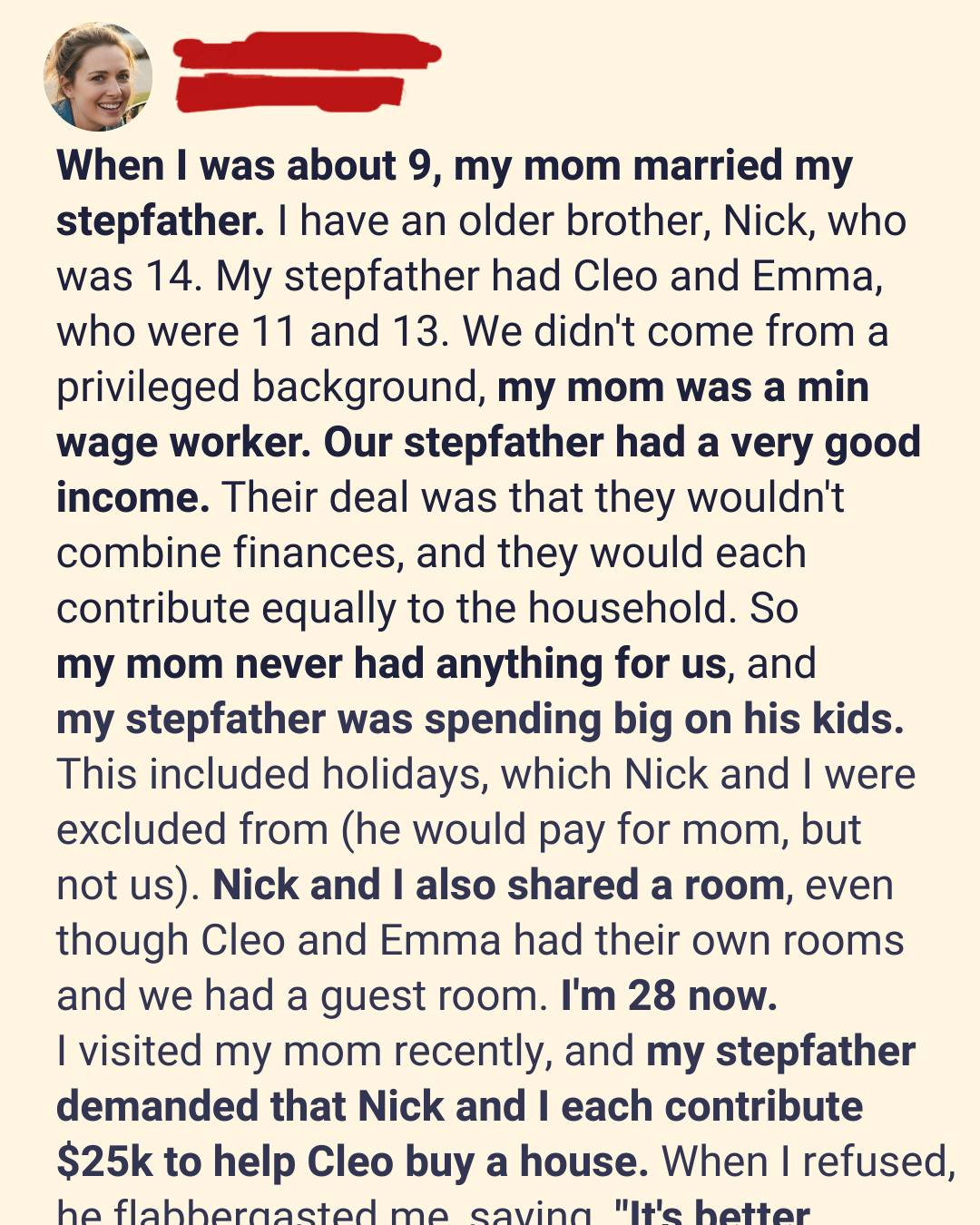
Growing up, I watched my stepdad take his daughters on vacations while my brother and I stayed behind. We were never treated as equals. I eventually thought I had left that part of my childhood in the past—until the day he asked me for $25,000 to help his daughter buy a house.
My father walked out when I was seven, leaving my mom to raise my older brother Nick and me alone. Nick was 12 at the time, already wrestling with teenage life while also trying to cope with our dad abandoning us. “Mom, why did Dad leave?” I remember asking one night as I curled up beside her on our old couch.
She gently stroked my hair. “Sometimes grown-ups make bad choices, sweetheart. But we’re going to be okay.”
But we weren’t okay—not really.
Mom worked minimum-wage jobs just to keep food on the table. I watched her count pennies at grocery store checkouts and make careful lists separating what we needed from what we simply wanted. We wanted a lot, but we got very little.
Two years later, Liam entered our lives. I’ll never forget the day Mom introduced him. She looked nervous, fidgeting with her hands the way she always did when she was anxious.
“Kids, I want you to meet someone special,” she said as a tall man with graying hair stepped into our tiny living room. “Hi there,” Liam greeted us with a practiced smile. “You must be Nick and Stacey.
Your mom talks about you all the time.”
Nick just grunted—he was at the age where everything was annoying. I, however, was curious about this man who made Mom smile again. What I didn’t know was that Liam came with his own baggage—two daughters from his previous marriage: Cleo, who was 11, and Emma, who was 13.
When Mom and Liam got married, our family of three suddenly became a family of six. Except… we weren’t really a family, at least not in the way you’d imagine. “We’ve decided to keep our finances separate,” Mom explained to Nick and me one evening.
“Liam and I will each contribute equally to household expenses.”
On the surface, that sounded fair. But it wasn’t. Mom was still earning minimum wage, barely scraping by, while Liam had a well-paying job.
“Equal” meant Mom struggled to cover her half while Liam had plenty left over to spend however he pleased. And he spent that leftover money on his daughters. “Dad’s taking us to Disney World!” Cleo proudly announced one morning at breakfast.
“That’s nice,” I said, assuming we were all going. “Just us girls and Mom,” Emma added, giving me a look that made it clear I wasn’t included. Mom shifted uncomfortably.
“Liam thought it would be nice for him to have some special time with his daughters.”
“What about us?” Nick asked. “Well, maybe next time,” Mom replied weakly. But next time never came—for us, anyway.
That became the pattern. Liam always paid for Mom to join their family trips, while Nick and I stayed home with whatever relative was available to watch us. But the vacations weren’t even the worst part.
It was living every day in a house that constantly reminded us that we were second-class. Cleo and Emma had their own bedrooms, complete with matching furniture and carefully decorated spaces. Nick and I shared a cramped room with bunk beds—even though the guest room stayed empty “for when Liam’s parents visit.”
“This isn’t fair,” Nick would whisper from the top bunk at night.
“I know,” I’d whisper back, staring at the ceiling. “But what can we do?”
We learned to live with less. We learned that love came with conditions.
And we learned that “family” didn’t always include the people who lived under the same roof. Years passed, and somehow we all grew up despite everything. Nick left for college at 18.
I remember him packing his beat-up duffel bag. “I’m getting out of here, Stace,” he said. “And when you’re old enough, you should too.”
“But what about Mom?” I asked.
He paused, folding his last shirt. “Mom made her choice. Now we have to make ours.”
When I turned 18, I took his advice.
I got into a decent college three states away and never looked back. Those four years were the best of my life: no favoritism, no watching Cleo and Emma get everything while I got nothing. College led to a good job, then an even better one.
By 28, I was doing well. I had my own apartment, a career I loved, and—most importantly—my independence. Nick was also doing great.
We both broke the cycle. But last month, something drew me back home. Maybe it was guilt about not visiting Mom enough.
“Stacey’s here!” Mom called out as I walked through the door. Everyone gathered in the living room. Cleo and Emma looked good—successful jobs, likely thanks to Liam’s help and connections.
After dinner, Liam asked to speak with me privately. We sat in his study, surrounded by his books and awards—the same room where he used to make “family decisions” that somehow never included Nick and me. “I need to talk to you about something important,” he said, his expression hard.
I waited, cautious. “You and Nick each need to give Cleo $25,000 for her house deposit.”
I froze. Then I actually laughed—it was either laugh or choke on the sheer audacity.
His face darkened. He leaned forward, scowling. “It’s better you do it if you hope to get any inheritance when your mother and I are gone,” he warned.
“Truth is, your mom’s contribution to this house was peanuts, so she won’t have much of a claim. No $150,000 deposit? No house for Cleo.
She’s got $100,000 already. Twenty-five she saved, 25 from her grandma, and 50 from me. She needs 50 more, and that’s on you two.
If you want to stay in this family, then you need to help her.”
I looked at him, stunned. After all these years, he still treated us like outsiders who had to earn our place. But I wasn’t that quiet kid anymore.
“Like how you ‘helped’ me and Nick when we were kids?” I asked. His eyes widened. “I don’t need your inheritance, Liam,” I told him as I stood up.
“I never counted on it. And if this is your version of family, you can keep it.”
I knew then that I needed to talk to Mom. A few days later, I found her in the kitchen making her morning coffee—the same kitchen where she used to count pennies for groceries while Liam’s daughters got everything they wanted.
“Mom, we need to talk,” I said, sitting across from her. She looked up, worry already in her eyes. “Is this about what Liam asked you?”
“It’s about everything, Mom.
I’m exhausted.” My words spilled out. “I’m tired of being treated like a second-class kid. I’m tired of watching you stand by while Liam demeaned Nick and me.
And if you keep enabling him, I’ll have no choice but to go no-contact.”
I watched her face fall apart. For the first time in 19 years, she looked truly broken. “Oh, sweetheart,” she whispered, tears filling her eyes.
“I’m tired of it, too.”
I never expected that. I always thought she accepted how things were. “Then why didn’t you ever say anything?”
“I was scared,” she admitted.
“After your father left, I was terrified of being alone again. I thought if I rocked the boat, Liam would leave, too.”
“But Mom—you sacrificed your children for that security.”
“I know,” she cried. “I know, and I hate myself for it.”
Then she revealed something I never saw coming.
“Stacey, there’s something Liam doesn’t know,” she said quietly. “I’ve been making extra payments on this house for years. Small amounts, but consistent.
I used money from your grandmother’s inheritance.”
My eyes widened. “What are you saying?”
“I actually own 40% of this house. It’s in my name through that separate inheritance.
Liam thinks I only contributed the minimum, but I’ve been secretly building equity.”
She dabbed at her tears with a napkin, hands trembling. For the first time, I saw not just my mother—but a woman who had been afraid, who had compromised, and who was finally finding the courage to make things right. I thought maybe things would change slowly—a few tense dinners, maybe Liam backing off.
But I didn’t expect what happened next. Last week, Nick called, unable to contain his excitement. “Stace, you’re not going to believe this,” he said.
“Liam put the house up for sale. He told Mom he needs to ‘free up liquidity for Cleo’s house.’”
“And?”
“He hit a legal snag. Turns out Mom’s name is on 40% of the deed, and she’s refusing to sign the sale papers.”
I felt genuinely happy—for the first time, Mom was finally standing up for herself.
“Liam’s furious,” Nick continued. “Cleo’s home purchase is stalled indefinitely. He can’t force Mom to sell without paying her out, and he definitely can’t afford that.”
The best part?
Mom told us she plans to leave her entire portion of the house to Nick and me. So yeah, Liam—thanks for reminding me I was never really family to you. And thank you for pushing my mom to finally see what she should’ve recognized long ago.
Because now, we’re done pretending. Nick and I built our own lives without your help. We found our worth without your approval.
And now, at last, Mom is choosing us—not out of guilt, but out of love and courage. Note: This story is a work of fiction inspired by real events. Names, characters, and details have been altered.
Any resemblance is coincidental. The author and publisher disclaim accuracy, liability, and responsibility for interpretations or reliance. All images are for illustration purposes only.