The phone rang at 2:17 p.m. on a Tuesday, an hour typically reserved for the dull rhythm of spreadsheets and fluorescent office lights.
I was staring at a grid of data that had lost all meaning when the vibration rattled against my mahogany desk. The office was a symphony of clicking keys and distant laughter, oblivious to the shift in the atmosphere.
I looked down at the unknown number and felt a strange hesitation. My thumb hovered over the screen as the second ring turned into a third, a heavy sensation settling in my lungs.
I finally swiped to answer, pressing the glass to my ear. “Is this Maya Sullivan?” a man asked, his voice steady and clinical.
“Yes, it is,” I replied, my voice sounding smaller than usual. “This is Sergeant Miller from the Phoenix Metro Police. Your daughter, Chloe, has been admitted to Valley North Hospital.”
The air in the room seemed to vanish instantly. “She is currently in stable condition, but you need to arrive as soon as possible,” he added.
“Stable?” I repeated, the word tasting like copper in my mouth. “What exactly happened to her?”
“The officers on-site will provide details when you get here,” he said with a professional detachment that made my skin crawl. “I should also inform you that the vehicle involved is registered in your name.”
The call disconnected before I could ask another question. I sat frozen for a long second, listening to the hum of the air conditioning while my hands began to shake uncontrollably.
I stood up so abruptly that my chair clattered against the floor, drawing a sharp look from a coworker nearby. I grabbed my purse and keys, moving toward the exit without a single thought for the work I was leaving behind.
“Maya, is everything alright?” my manager asked, stepping into my path with a look of feigned concern. “Family emergency, I have to go now,” I muttered, pushing past him toward the elevator.
The ride down felt agonizingly slow, each floor stop feeling like a personal insult to my urgency. When I burst into the parking garage, the Arizona heat hit me like a physical blow, thick and suffocating.
I ran toward my designated spot, my breath hitching in my chest. I came to a dead stop when I saw nothing but empty asphalt and painted white lines where my SUV should have been.
Then, the realization crashed over me with the force of a tidal wave. I had lent my car to my sister, Bridget, that morning after she called me with a cheerful, entitled plea.
“We want to take the kids to the Sun Valley Water Park, but our van is in the shop,” she had said over breakfast. “Can we use yours so we can all fit together?”
My mother had jumped on the line too, adding her soft, persuasive pressure. “It will be wonderful for Chloe to spend the day with her cousins, Maya,” she had insisted.
I had been too tired to argue, so I handed over the keys, thinking I was being a good daughter and sister. Now, I was standing in a hot garage, frantically summoning a ride-share app while pacing in tight, panicked circles.
The app informed me my driver was four minutes away, but those minutes felt like hours of mental torture. When the car finally arrived, I scrambled into the back seat before the driver could even say hello.
“Valley North Hospital, please, as fast as you can,” I told him, my voice cracking. “Traffic is a mess at this hour, ma’am,” he replied, glancing at me through the rearview mirror.
The city seemed to conspire against me, with every light turning red the moment we approached. I watched people walking dogs and sipping iced coffees, wondering how the world could be so normal when mine was falling apart.
I tried calling my mother, but it went straight to voicemail. I tried Bridget three times, but she didn’t pick up, leaving me with nothing but the sound of a ringing tone.
When we pulled up to the hospital entrance, I sprinted through the sliding glass doors into the refrigerated air of the lobby. “I’m Maya Sullivan, my daughter Chloe was brought in by the police,” I gasped at the reception desk.
The woman looked at her computer and then gave me a look of practiced sympathy. “Yes, she is in the pediatric ward, but a nurse needs to speak with you before you go back.”
“I just need to see her,” I pleaded, my heart hammering against my ribs. “I understand, but please fill out these forms and provide your identification first,” she insisted.
A few minutes later, a nurse named Sarah approached me with a somber expression. “Mrs. Sullivan, Chloe is awake and she is going to be okay,” she said gently.
I let out a sob of relief, but the nurse didn’t smile back. “She was found alone in a locked vehicle in a shopping center parking lot,” Sarah continued.
The world tilted on its axis as I stared at her in disbelief. “Because of the circumstances and the heat index, we were required to contact Child Protective Services and the police,” she explained.
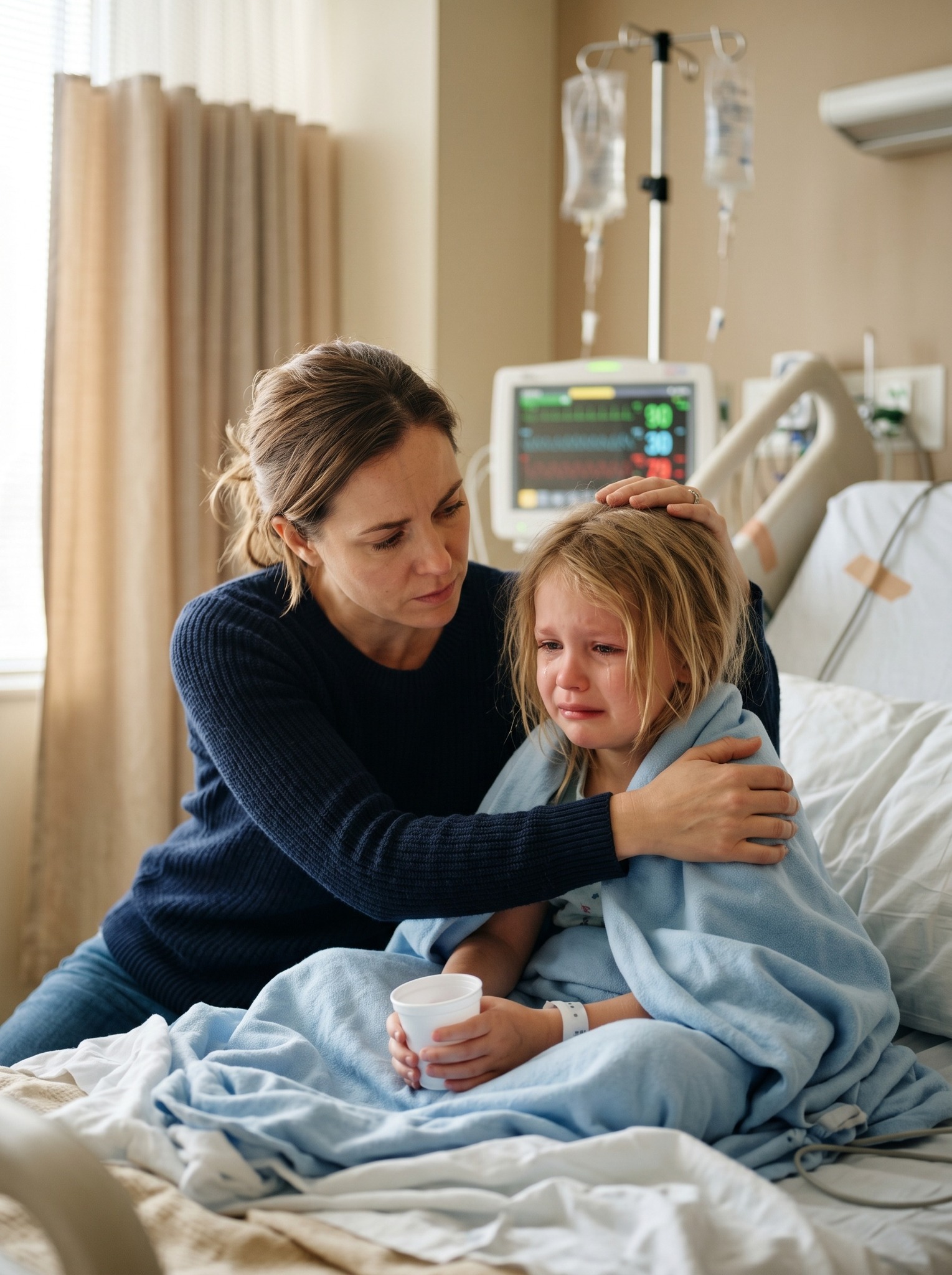
I followed her down a long, sterile hallway, my legs feeling like they were made of lead. When she pushed open the door to a private room, I saw Chloe sitting on the edge of a high hospital bed.
Her face was beet red, and her hair was matted with sweat, making her look incredibly small. “Mommy!” she wailed the moment she saw me, her face crumpling into tears.
I rushed to her, pulling her into my arms and holding her so tightly I could feel her heart racing. She sobbed into my shoulder, her tiny fingers clutching my shirt as if she were afraid I would disappear.
“I’m here, baby, I’ve got you,” I whispered, though my own tears were blurring my vision. She smelled like salt and hospital soap, her body still radiating a terrifying amount of heat.
“I was so thirsty,” she whimpered between hiccups. “I tried to get out, but the door wouldn’t open.”
The nurse stood by the door, waiting for the crying to subside before she spoke again. “A passerby saw her banging on the window and called for help,” she told me.
“How long was she in there?” I asked, my voice trembling with a mixture of fear and growing rage. “The police are still investigating, but based on her dehydration levels, it was a significant amount of time,” the nurse replied.
Sergeant Miller appeared in the doorway then, looking weary and unimpressed by the drama. “Ms. Sullivan, I need to take a statement from you in the hallway,” he said.
I kissed Chloe’s forehead and stepped outside, where my husband, Simon, had just arrived looking pale and frantic. “Where were you today, Maya?” the officer asked, pen poised over a notepad.
“I was at my office in Scottsdale all day,” I said, pointing to my work badge. “And who was responsible for the child today?” he continued.
“My sister, Bridget, and my parents, Diane and Paul,” I replied, the names feeling like ash in my mouth. “The car is yours, but they had custody of the girl?” he clarified.
“Yes, I lent it to them for a trip to the water park,” I explained. “We will be in touch for a formal interview, but for now, do not discuss the case with them,” Miller warned.
I ignored his advice the moment he walked away and pulled out my phone to call Bridget. She picked up on the second ring, sounding completely relaxed and happy.
“Maya! You wouldn’t believe the crowd at the park today, the kids are having a blast,” she chirped. “Where is Chloe, Bridget?” I asked, my voice dangerously low.
There was a brief pause on the other end of the line. “Oh, she’s in the car taking a nap,” Bridget said, her tone shifting to one of slight annoyance.
“You left her in the car?” I asked, my blood beginning to boil. “She was being a brat and throwing a tantrum, so we told her she had to sit in the car until she calmed down,” Bridget explained.
“It is 105 degrees outside, Bridget!” I screamed into the phone. “Calm down, Maya, we parked in the shade and left the window cracked an inch,” she shot back.
“She is in the emergency room right now because the police had to break into my car to save her life,” I said. The silence on the other end was heavy and deafening for several seconds.
“Is she okay?” Bridget finally asked, though she sounded more worried about herself than Chloe. “She is alive, no thanks to you,” I snapped.
“Well, if she’s fine, then there’s no need to be so dramatic about it,” Bridget said, her voice turning defensive. “The police are involved and they have my car, Bridget,” I told her.
“You’re going to make us look like monsters over a simple mistake,” she complained before hanging up. I stared at the phone in shock, realizing that my family was already looking for a way to blame me.
I went back into the room and sat by Chloe, watching her sleep as the IV fluids dripped into her arm. I thought back to my childhood, remembering how Bridget was always the golden child who could do no wrong.
When I was eight, she locked me in a dark shed behind our house for three hours just to see if I would cry. When my parents finally found me, they scolded me for “upsetting” Bridget on her birthday.
“Maya is the strong one, she can handle anything,” my mother used to say to justify my sister’s cruelty. I realized then that I had spent my entire life being the “strong one” so they could be reckless.
The next morning, I was sitting at my kitchen table when my mother, Diane, called me. “Maya, sweetheart, we need to talk about what you’re going to tell the authorities,” she began.
“I’m going to tell them exactly what happened, Mom,” I said. “If you do that, Bridget will lose her chance at that new daycare job she’s applying for,” Diane argued.
“She left my daughter to bake in a car, she shouldn’t be anywhere near children,” I replied. “Family protects family, Maya, and if you don’t help her, you are no daughter of mine,” she threatened.
The old fear of being cast out flickered for a second, but then I looked at the red marks on Chloe’s arms. “Then I guess I don’t have a mother anymore,” I said, and I hung up the phone.
I spent the rest of the afternoon gathering every text message and photo Bridget had sent me that day. I found her social media posts showing her and my parents eating churros while Chloe was trapped in the parking lot.
When I went to the police station for my formal statement, I handed over a folder full of evidence. “I want to make sure there is a full record of who was responsible for her today,” I told Sergeant Miller.
A week later, the legal system began to grind forward with a cold, unrelenting precision. Bridget and my parents were charged with child endangerment, and a judge issued a restraining order.
My parents lost their retirement savings paying for lawyers, and Bridget lost her job prospects instantly. They sent me hateful messages, accusing me of destroying the family for the sake of “revenge.”
I didn’t feel like I was getting revenge; I felt like I was finally setting a boundary that should have existed years ago. Chloe started seeing a play therapist to deal with her newfound fear of being left alone.
“Will you be right outside the door, Mommy?” she asked during her first session. “I will be exactly where I said I would be, I promise,” I told her, holding her hand.
It took months for the nightmares to fade and for Chloe to stop checking the locks on the car. One afternoon, we were sitting in the backyard of our home in Mesa, watching the sunset.
“I’m glad we don’t go to Grandma’s house anymore,” Chloe said suddenly, her eyes focused on her doll. “Why is that, honey?” I asked.
“Because you’re the only one who hears me when I’m scared,” she replied simply. I pulled her into my lap and kissed the top of her head, feeling a sense of peace I hadn’t known was possible.
I had lost my sister and my parents, but I had saved my daughter and myself. I wasn’t the “strong one” for them anymore; I was finally strong enough for us.
THE END.